Futures position sizing works backward from a defined price-and-cost scenario to a contract quantity. This guide covers a USDT-settled linear short: calculate a risk limit, estimate capital commitment using Bybit's three-part order-cost framework, take the smaller quantity and round down. Stop if product specifications, account risk or execution conditions remain unclear. A calculated quantity does not guarantee that an order can open or that losses will stay within budget.
One trader budgets 50 USDT and calculates 0.072 BTC. Another gets 0.062 BTC. Before placing an order, the quantity falls again to 0.050 BTC. Which answer is right? The first may include only price movement, the second adds costs, and the third also checks a capital limit. Different inputs should produce different quantities.
What matters is whether you can trace every number: what the 50 covers, how far away the stop sits, which costs change with size, and how much capital the account can commit. We will reuse a known BTC price plan, calculate both limits, then check the historical price sequence. There is no need to start by choosing higher leverage or turn a losing example into a winning one.
Key takeaways
- Risk budget divided by loss per unit gives the underlying quantity. Notional value and margin need separate calculations.
- A cost-inclusive risk limit and a capital limit answer different questions. Both must pass.
- Record the proposed quantity, actual filled quantity and final net result separately.
Position quantity, notional value and risk budget
These three values answer different questions: how much you hold, how large the exposure is, and how much you budget for the trade. Calling all of them “trade size” makes it easy to mix units. BTC means bitcoin; USDT is the stablecoin used for quoting and settlement here. Neither stablecoins nor exchanges are risk-free. A short has positive price profit and loss (P&L) when the price falls and is closed by buying back the position.
This guide covers linear contracts measured in BTC, with P&L settled in USDT. The formulas do not carry straight over to coin-margined inverse contracts, traditional futures contract counts or forex lots. For the broader product workflow, see the perpetual futures guide. Everything needed for this calculation is explained below.
Budget divided by stop distance gives a BTC quantity
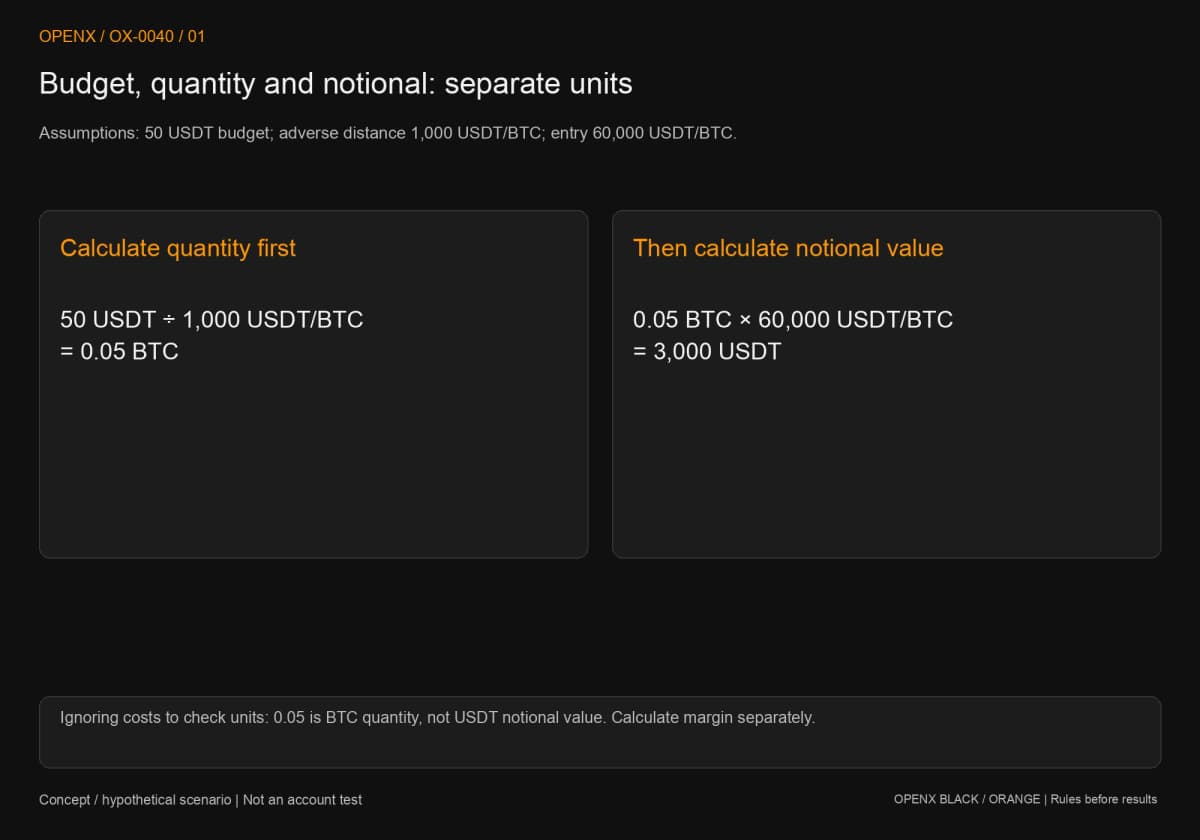
Ignoring costs, the price loss on a short is BTC quantity multiplied by the adverse price difference per BTC. A 50 USDT budget and a 1,000 USDT/BTC stop distance give 0.05 BTC. At an assumed entry price of 60,000 USDT/BTC, the notional value is then 3,000 USDT. These are hypothetical numbers, not an actual trade.
The units provide a useful check: USDT divided by USDT/BTC leaves BTC. The result is not 0.05 USDT of notional value. Bybit's P&L Calculations, dated August 12, 2026, explains USDT linear P&L using contract quantity and the entry-to-exit price difference. Fees and reserves below are separate teaching inputs, not hidden components of price P&L.
Leverage changes capital requirements, not your stop choice
With the same quantity and entry and exit prices, changing leverage from 5× to 10× does not double price P&L. It changes margin requirements and opening conditions. Bybit's P&L documentation also separates these effects. P&L grows only if you also increase the quantity.
Set the stop from the trading conditions first, then calculate quantity. Moving a stop closer just to retain a desired quantity creates a different entry-and-exit plan. This guide does not establish that any particular stop distance has an edge; it shows how to calculate size once the rules are fixed.
A cost-inclusive quantity must also fit the capital limit
A trade may fit its planned loss scenario yet require more opening capital than you want to allocate. The first constraint limits the scenario's adverse price movement and costs. The second limits the capital committed to opening. Both must hold, followed by the platform's product, account and risk checks.
Include entry fees, exit fees and assumed exit slippage
For a short, let E be the entry price, S the stop price, and d the assumed adverse exit slippage per BTC. The scenario exit price is S + d. Slippage is the difference between an expected price and the actual fill. Here, d is an estimate, not a guaranteed maximum. Entry and exit fee rates may differ; apply each rate to its own traded value before adding the price loss.
If B is the risk budget and F is a fixed funding reserve, divide B − F by the scenario cost per BTC. Funding is a payment between perpetual long and short holders under the contract's settlement rules. F merely reserves a possible expense; it does not mean a funding payment occurred. If B is no greater than F, no budget remains for price movement and trading fees, so stop.
Take the smaller limit, then check product specifications
Keep capital commitment in a separate column. Bybit's Order Cost, dated June 28, 2026, separates initial margin, opening fees and estimated closing fees. That is different from simply dividing notional value by leverage. We borrow this structure for an illustrative short, not as a statement of every platform's current debit.
Take the smaller of the risk-based and capital-based limits, then round down to the chosen quantity step. The step specifies allowed increments; minimum quantity and minimum notional value are separate requirements. Cancel if the rounded result fails them. Do not round up to force an order through. Binance's official Public API Parameters lists separate quantity and price filters; this example does not substitute current specifications for historical ones.
BTC example: why a 50 USDT budget leads to 0.050 BTC
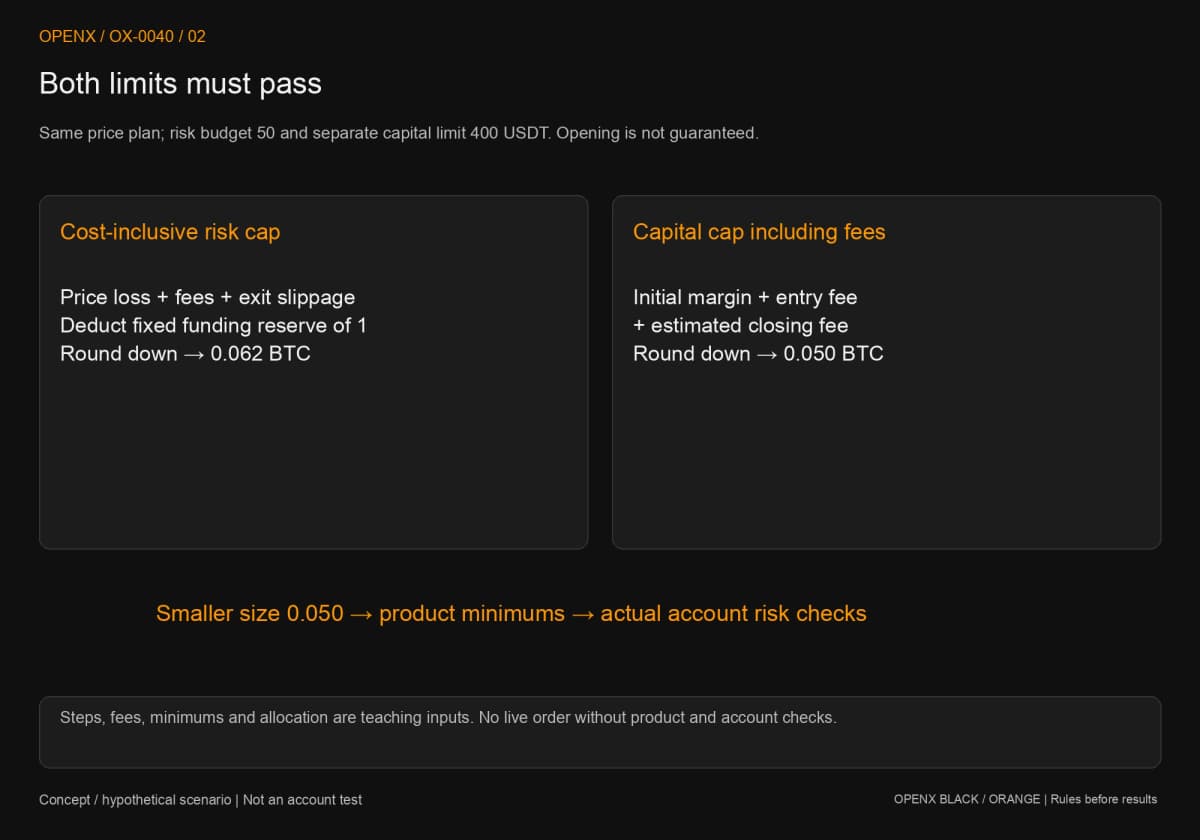
We retain the original price plan and add a hypothetical capital limit of 400 USDT. That is an allocation for this exercise, not a balance retrieved from an exchange. The risk calculation will allow 0.062 BTC, while the capital calculation reduces the candidate to 0.050 BTC. The two answers are compatible.
Step 1: fix the price plan and cost assumptions
The example uses Binance BTCUSDT perpetual historical prices from its USDⓈ-M Futures Kline/Candlestick Data for September 10–11, 2026. A four-hour plan is checked against 15-minute candles to establish the entry-to-exit order. All times are UTC; add eight hours for Taiwan time. Candles are named by opening time, but their full range is known only after closing. This is a teaching exercise using known history, with no actual orders. Quantities, fills and costs are assumptions, not trading performance.
The plan was confirmed at 16:00 on September 10. It assumes a limit short on the first retest of 77,912.2, a price stop at 78,600.0 and a target at 76,536.6. Wait six four-hour candles after confirmation; cancel if there is no touch before 16:00 on September 11. Before entry, also cancel if a four-hour candle closes above the original zone's upper edge, 78,543.9, or a subsequent 15-minute candle opens above that edge. The order-block retest and invalidation guide explains the zone's origin. Sizing itself requires no additional indicator.
We use last traded price candles for touches and assume the entry limit fills in full. A conditional market buy closes the short when price reaches or exceeds the stop; a buy limit handles the target. Teaching inputs are a 0.05% fee on each side, 20 USDT/BTC of adverse exit slippage, a 1 USDT funding reserve, a 0.001 BTC quantity step, a 0.001 BTC minimum quantity, a 5 USDT minimum notional value and 10× leverage. No orders were submitted.
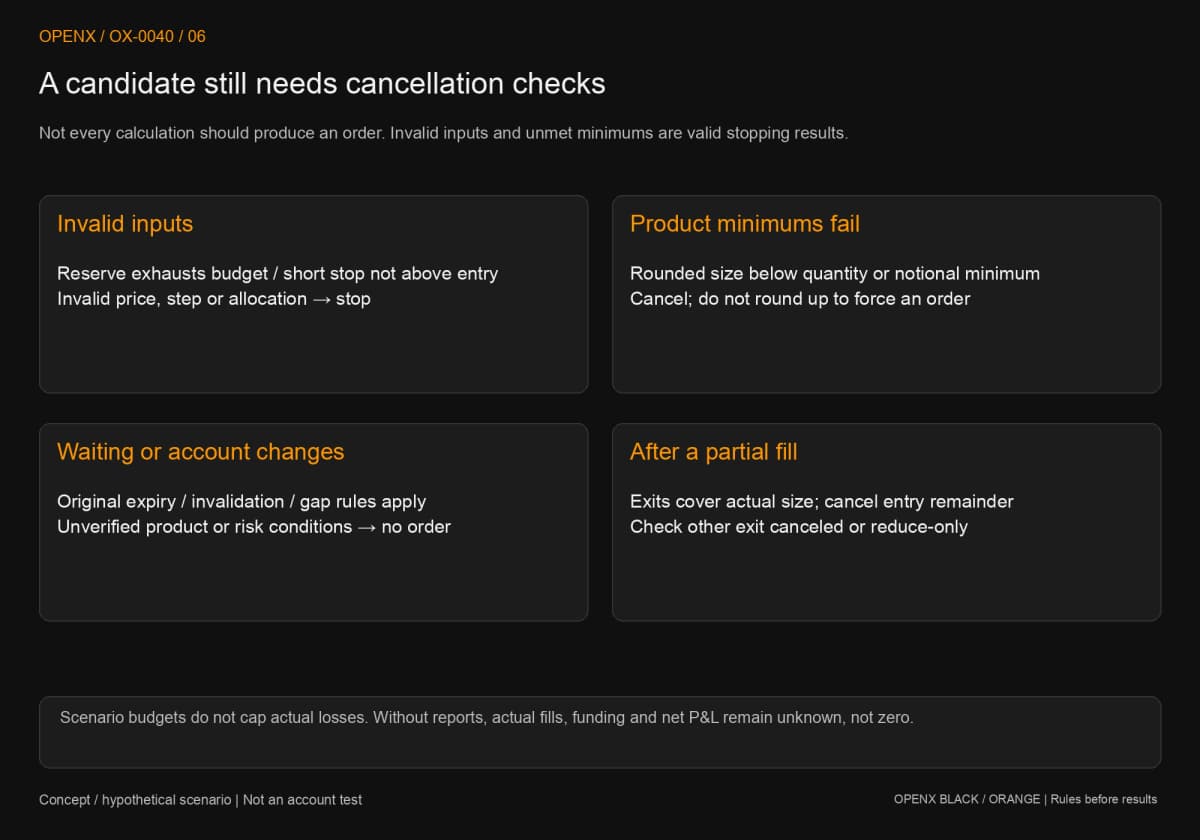
The plan also cancels any unfilled entry remainder when an exit triggers or the original plan is canceled. Exit quantity must cover only the actual position. After either exit completes, check that the other is canceled or restricted to reduce-only, preventing a leftover order from opening the opposite position. Reduce-only prevents an order from increasing a position; conditional exits also need their close-on-trigger settings checked. Bybit's Reduce-Only Order and Close On Trigger, both dated June 29, 2026, explain these uses separately. Platform support and linked cancellation rules still need verification; labeling an order “close short” does not make every safeguard automatic.
Step 2: the risk-based limit is 0.062 BTC
The stop distance is 78,600.0 − 77,912.2 = 687.8 USDT/BTC. At 0.072 BTC, price risk alone is 49.5216 USDT. Adding hypothetical round-trip fees of 5.6344392 USDT at the original specified prices brings the total to 55.1560392, already above 50 before slippage. This reveals what the first formula omitted, not fees actually charged to a historical account.
With 20 USDT/BTC of slippage, the scenario exit is 78,620.0. The scenario cost per BTC is:
(78,620.0 − 77,912.2) + 77,912.2 × 0.0005 + 78,620.0 × 0.0005 = 786.0661 USDT.
Deduct the 1 USDT reserve, divide 49 by 786.0661, then round down in 0.001 BTC steps: 0.062 BTC. Substituting it back gives 49.7360982 USDT including the reserve. That passes only the first limit; the 400 USDT capital constraint is still unchecked.
Step 3: the 400 USDT capital limit reduces size to 0.050 BTC
For this short, we estimate initial margin from the order price and reserve an estimated closing fee at the same illustrative rate. Estimated capital per BTC is:
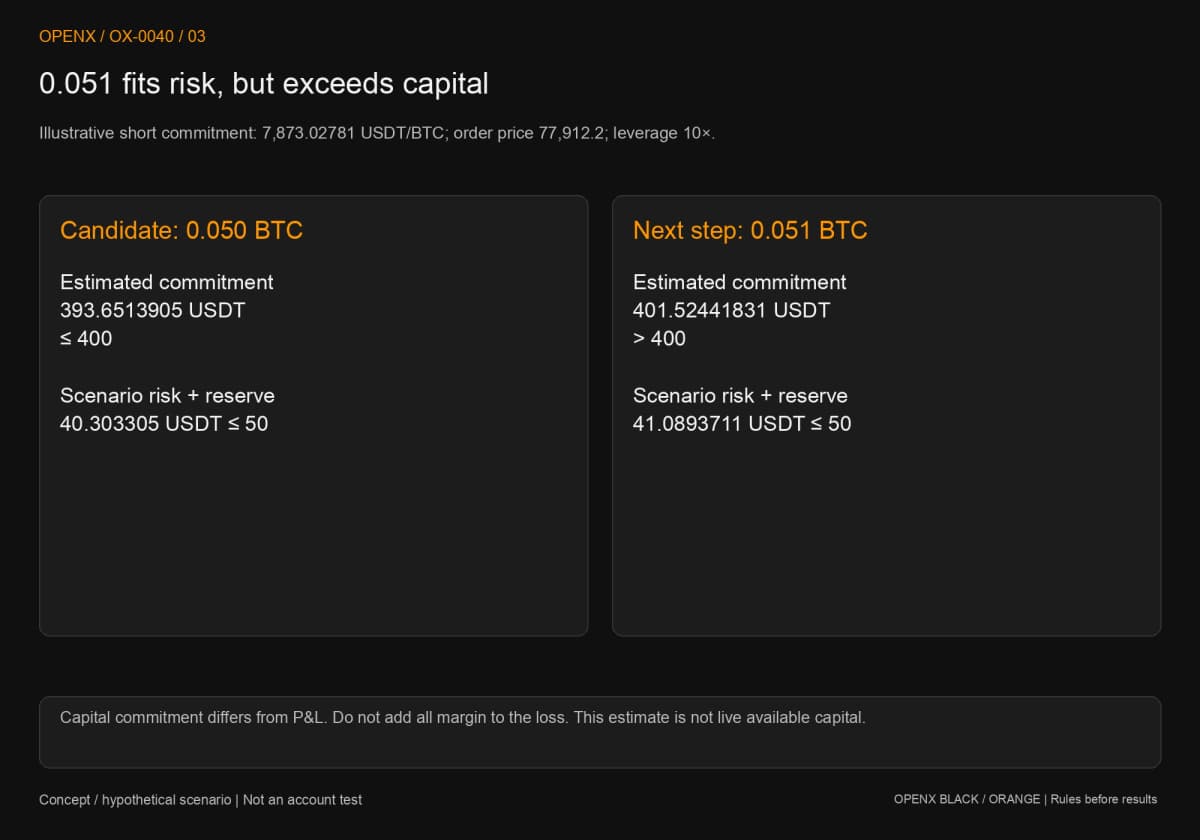
77,912.2 ÷ 10 + 77,912.2 × 0.0005 + 77,912.2 × (1 + 1 ÷ 10) × 0.0005 = 7,873.02781 USDT.
The three terms are simplified initial margin, opening fee and estimated short closing fee. Using the same rate throughout is an assumption, not a current fee schedule. Divide 400 by 7,873.02781 and round down: 0.050 BTC. At 0.051 BTC, estimated commitment would be 401.52441831 USDT, above the limit.
Take the smaller of 0.062 and 0.050: 0.050 BTC. Its notional value is 3,895.61 USDT and estimated capital commitment is 393.6513905 USDT. Scenario price loss is 35.39, hypothetical round-trip fees are 3.913305, and adding the 1 USDT reserve gives 40.303305. Both teaching constraints pass. There is no need to use every remaining dollar of the risk budget.
An estimated closing fee in the capital calculation represents reserved funds; in the P&L calculation, fees use the assumed exit price. Do not add the entire 393.6513905 capital commitment to the 40.303305 scenario loss. Also distinguish mark price, a reference used for valuation and risk, from the last traded price. Bybit's Initial Margin, dated April 30, 2026, values positions using mark price. This order-price estimate cannot replace actual position margin, available capital or liquidation checks.
Step 4: change one input set at a time and keep each version
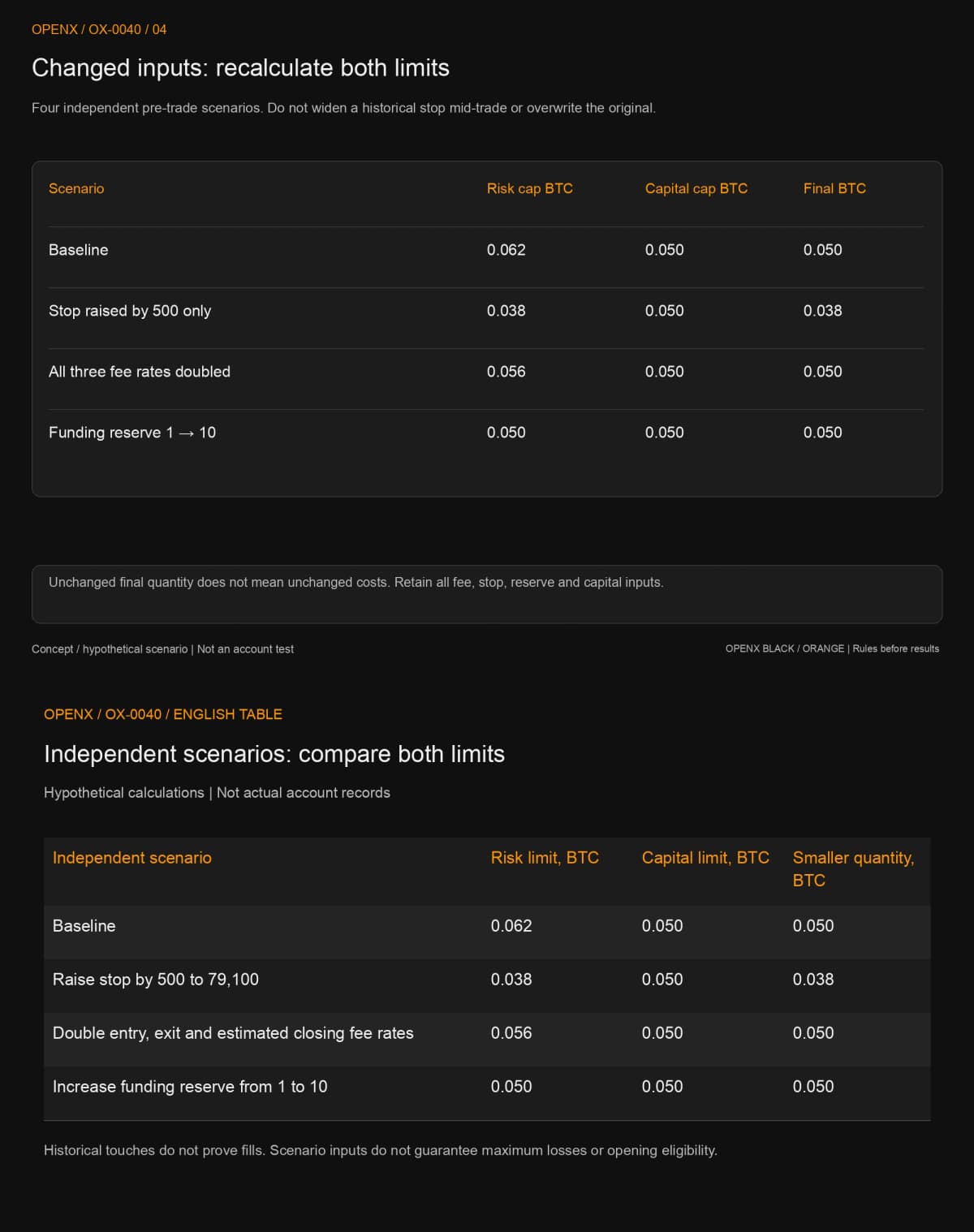
The following are four independent pre-trade scenarios. Unchanged inputs stay fixed. Raising the stop tests quantity; it does not authorize widening the stop after seeing how an open trade develops. Save a new calculation rather than overwriting the original plan.
| Independent scenario | Risk limit, BTC | Capital limit, BTC | Smaller quantity, BTC |
|---|---|---|---|
| Baseline | 0.062 | 0.050 | 0.050 |
| Raise stop by 500 to 79,100 | 0.038 | 0.050 | 0.038 |
| Double entry, exit and estimated closing fee rates | 0.056 | 0.050 | 0.050 |
| Increase funding reserve from 1 to 10 | 0.050 | 0.050 | 0.050 |
A lower risk limit does not always reduce final size immediately, because capital may already be the tighter constraint. Conversely, an unchanged 0.050 BTC does not mean fees had no effect: doubling rates changes total scenario cost. Keep risk limit, capital limit, rounded candidate and substituted totals in separate spreadsheet columns, rather than one “recommended quantity” cell.
Step 5: distinguish historical touches from fills
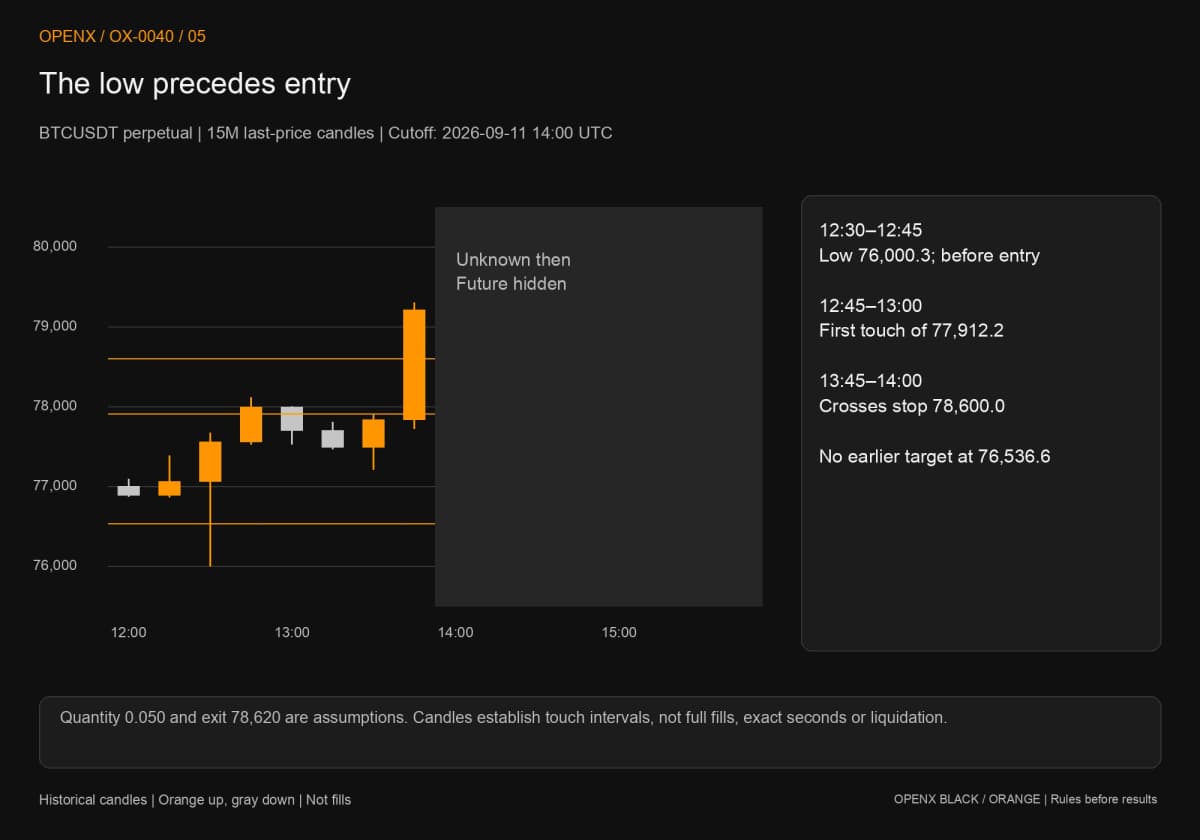
The first five four-hour candles after confirmation never reached 77,912.2. On September 11, the 12:30–12:45 candle reached a low of 76,000.3 before entry, while its high of 77,671.4 remained below entry. That decline cannot count as profit on this short. The first entry touch is within 12:45–13:00, with a high of 78,115.4 and low of 77,527.8. This identifies a 15-minute interval, not a fill at exactly 12:45.
The next candles, opening at 13:00, 13:15 and 13:30, have lows of 77,526.4, 77,464.6 and 77,211.4, all above the 76,536.6 target. During 13:45–14:00, the high of 79,300.7 crosses the stop, while the low of 77,720.0 still misses the target. Entry and stop occur in different 15-minute intervals, so the simplified model reaches the stop first. The original price target does not automatically become a net profit equal to twice the cost-inclusive budget.
Only by applying 0.050 BTC and the hypothetical 78,620 exit do we get the earlier 40.303305 scenario including the reserve. Candles contain no order queue, actual average fill or funding statement; leave those actual-result fields blank. In a separate partial-fill assumption, only 0.030 BTC fills. Configure exits for that 0.030, cancel the unfilled 0.020 when an exit triggers or the plan ends, and check the other exit after closing. This is another hypothetical scenario, not a historical execution report.
When to cancel a calculated quantity
Stopping rules matter as much as the arithmetic. Stop if the reserve exhausts the budget, a short's stop is not above entry, or a price or quantity step is invalid. Cancel if rounding down leaves quantity or notional value below the minimum. With a 1.5 USDT budget and the same 1 USDT reserve, these inputs produce less than one quantity step. Do not raise leverage or round up to manufacture an order.
After the teaching calculation passes, check actual specifications, fees, available capital, other positions and exit settings. Bybit's FAQ — Order Execution and Liquidation, dated September 25, 2026, distinguishes triggering from execution and notes that limits may fill partially or not at all. A platform confirmation screen can also differ from an offline estimate because conditions have changed. Resolve the difference before treating a candidate as a live-ready order.
Keep inputs and results in one record
A traceable calculation retains its inputs, both limits, the rounded candidate and cancellation reasons. Save each input change as a new version. Actual fills and net P&L wait until account records are complete; a spreadsheet result is not a fill. The trading journal fields and templates provide the next step.
For which funds can support a position, continue with isolated vs cross margin. For reconciliation, read futures trading costs: fees, slippage and net P&L. Neither replaces the two limits here or turns a single historical outcome into strategy performance.
This article is for education and historical calculation practice, not investment advice. Fees, slippage, funding, specifications and account conditions can change. A teaching budget or candidate quantity guarantees neither a maximum actual loss nor permission to open a position.