Isolated and cross margin define which funds support positions. Isolated margin manages position margin separately; cross margin lets eligible funds support related positions together. If you want separate allocations, Bybit's Unified Trading Account documentation still requires checking isolated top-up settings. Cross margin suits only an arrangement in which you can manage account-wide interactions. Neither mode replaces risk controls or guarantees a maximum loss. If the scope is unclear, resolve it before switching.
You allocate 1,000 USDT to a position and have another 1,000 in the account. If the position loses money, can the rest be used? “I chose isolated margin” leaves another question unanswered: are automatic top-ups enabled, and how much have you transferred since opening? With cross margin, adding the available amount shown for two positions does not create a second pool of money.
I find a ledger that reconciles to its starting total more useful than memorizing which mode beginners should choose. We will explain allocation, top-ups and setting scope, then follow the same 2,000 USDT through three branches: isolated without a top-up, isolated with a top-up and cross margin. These are teaching allocations, not a replay of a real account's liquidation. Liquidation means the platform takes over or forcibly reduces a position under its risk rules.
Key takeaways
- Margin mode determines which funds support positions. A strategy stop remains a separate rule.
- Adding margin changes allocation; without a new fill, it does not increase contract quantity.
- Cross margin shares capital and links position risks. Sharing does not double the funds.
Which funds support which position?
Isolated and cross margin are funding arrangements, not long or short directions or profit strategies. Isolated margin separates individual position margin. Cross margin shares funds within the permitted scope. They change how the account supports risk, not the price profit and loss (P&L) of an identical quantity at identical entry and exit prices.
This guide uses USDT stablecoin funds and linear contracts, where price P&L is quantity multiplied by the price difference. It excludes borrowing, other collateral currencies, options and portfolio margin. The perpetual futures guide covers the broader product and sizing workflow; the concepts needed for this ledger are explained here.
Initial margin, maintenance margin and your risk budget differ
Initial margin is capital required to establish a position. Maintenance margin is the requirement for keeping it open. Your own decision to budget a 50 USDT loss does not cause the platform to isolate exactly 50 USDT. Even a 1,000 USDT initial isolated allocation is not the same as a strategy stop.
Bybit's Margin Calculations Under Different Margin Modes, dated August 7, 2026, explains position margin and estimated closing fees. Calculate quantity from the trading conditions first, then check the margin arrangement. Adding funds must not quietly replace the planned stop. The stop-distance and position-sizing example develops that calculation.
Cross margin shares eligible funds, not automatically every asset
Cross margin still has boundaries: the account, eligible collateral, products and treatment of unrealized P&L all depend on platform rules. An asset balance does not prove that collateral is enabled, that the asset counts at full value, or that it supports the position you are viewing.
Bybit's Differences Between the Margin Modes Under the Unified Trading Account, dated August 4, 2026, distinguishes isolated settlement assets from eligible collateral under cross margin. OKX's How to Trade Using Cross and Isolated Margin Modes, dated September 2, 2026, describes sharing the same margin asset and notes that availability may differ by user. A statement from either page cannot be generalized to every platform, account and asset.
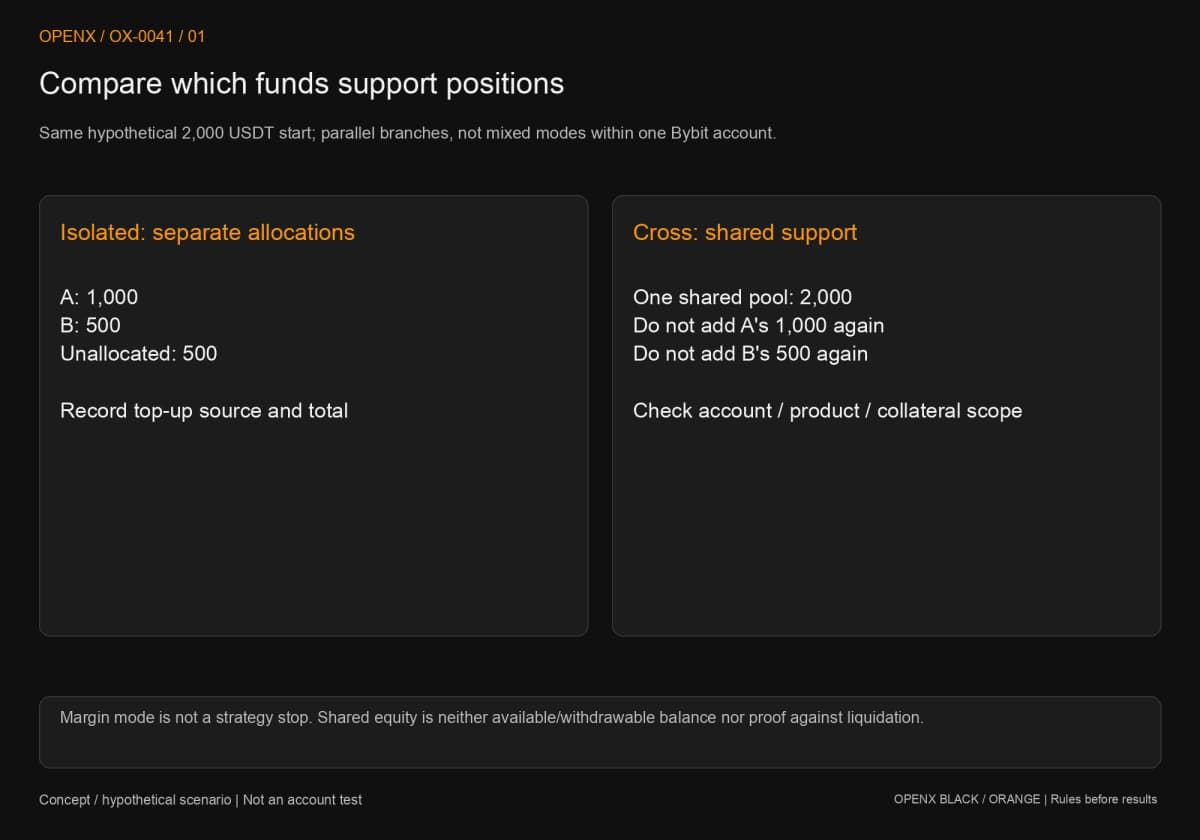
Can isolated margin receive more funds?
Yes. Manual transfers or automatic replenishment can expand the funds allocated to an isolated position under its current settings. Check how much is allocated now, where additional funds may come from, and which settings can change that scope. The original amount is not a permanent description of the funds currently committed to supporting the position.
Adding margin does not add contract quantity
A manual margin top-up allocates funds to an existing position. Adding to a position requires a new fill that increases contract quantity. Without a trade, a top-up does not change the quantity multiplier in price P&L. A new fill changes exposure and usually requires recalculating average entry, margin and exit quantity. Both may feel like “putting more money in,” but one is a transfer and the other an execution event.
AMR means Auto-Margin Replenishment. Bybit's documentation of that name, dated March 25, 2026, describes replenishment from available balance in isolated mode, subject to product and trigger rules. It does not guarantee prevention of liquidation. We use the mechanism to explain funding boundaries, not the document's liquidation-price example. The 300 USDT transfer below is not a platform default top-up amount.
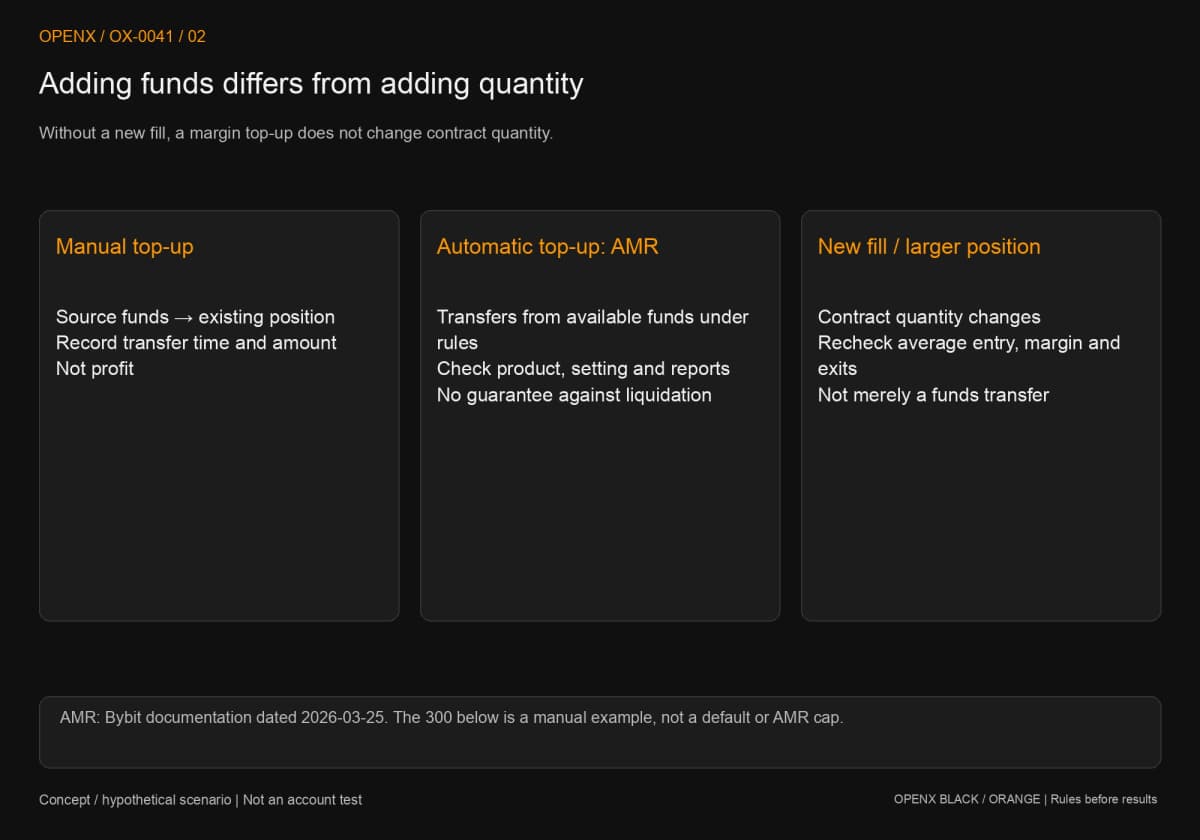
A mode switch may apply to the whole account
Check the scope before choosing a mode. The Bybit Unified Trading Account document above specifies account-level application: within that account type, you cannot freely assign different margin modes to different trading pairs. The isolated and cross examples below are parallel branches from the same starting point, not a claim that they coexist in that Bybit account.
List affected positions and orders before checking switching requirements. Also separate margin mode from one-way or hedge position mode. The former concerns funding support; the latter concerns whether long and short positions can coexist. A platform's split-position display does not necessarily mean separate risk accounting.
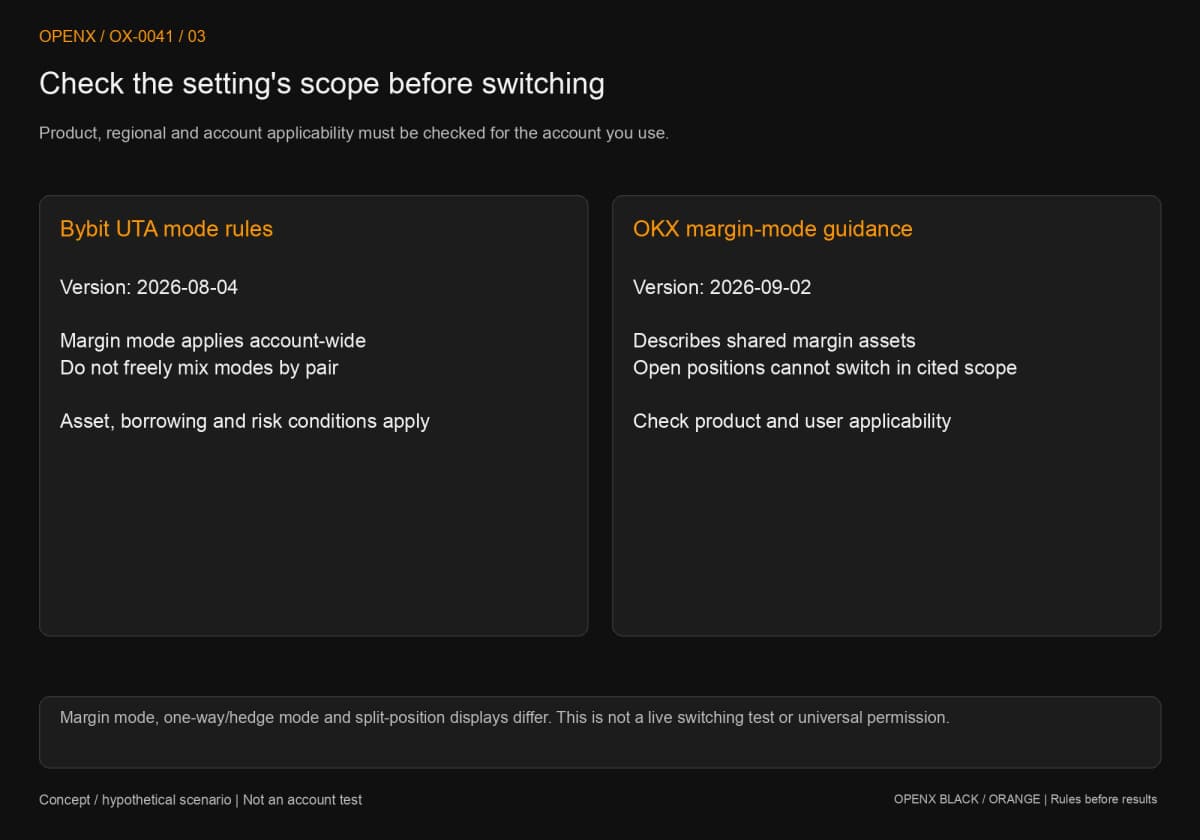
Follow one 2,000 USDT ledger through three branches
Fix the 2,000 USDT starting total and two hypothetical losses before comparing allocation. All three branches incur the same economic losses, so total equity should match. A top-up moves funds; it does not erase losses. This exercise does not calculate platform maintenance margin or a liquidation time, and it does not prove the positions could remain open throughout.
Step 1: define A, B and unallocated funds
Start with 2,000 USDT: allocate 1,000 to A, 500 to B and leave 500 unallocated. Quantities are fixed and both positions start with zero unrealized P&L. A and B are labels, not particular coins, orders or historical prices. Assume no borrowing, funding, other collateral or remaining orders. Fees enter only in the final separate step.
Unrealized P&L is price P&L before a position closes. In this ledger, equity means starting funds plus the specified P&L. The isolated branches track A, B and unallocated funds separately. Cross margin starts with one shared 2,000 USDT pool; the 1,000 and 500 are not additional assets outside it. Actual platform fields may use different definitions, which must be checked before reconciliation.
First assume A loses 200, then B loses 300. These are stress scenarios, not forecasts. A separate branch transfers 300 from unallocated funds to A after A's loss. Fixing amounts and order lets us see that a top-up changes the allocation of supporting funds, not the loss already incurred.
Step 2: record A's 200 USDT loss
Without an isolated top-up, A's illustrative equity is 1,000 − 200 = 800. B remains 500 and unallocated funds remain 500. Total equity is 800 + 500 + 500 = 1,800. The loss is already in A's column; deducting it again from unallocated funds would count it twice.
The cross branch records only shared equity: 2,000 − 200 = 1,800. This is not all immediately tradable or withdrawable. It has not accounted for platform commitments, maintenance requirements or other liabilities. It shows that A's loss has changed the shared funding state.
Both totals are 1,800, but the support relationships differ. The isolated no-top-up branch has not moved its unallocated 500 to A. In cross margin, do not copy the shared 1,800 into both A and B and claim 3,600. Two views of an account still describe one pool of money.
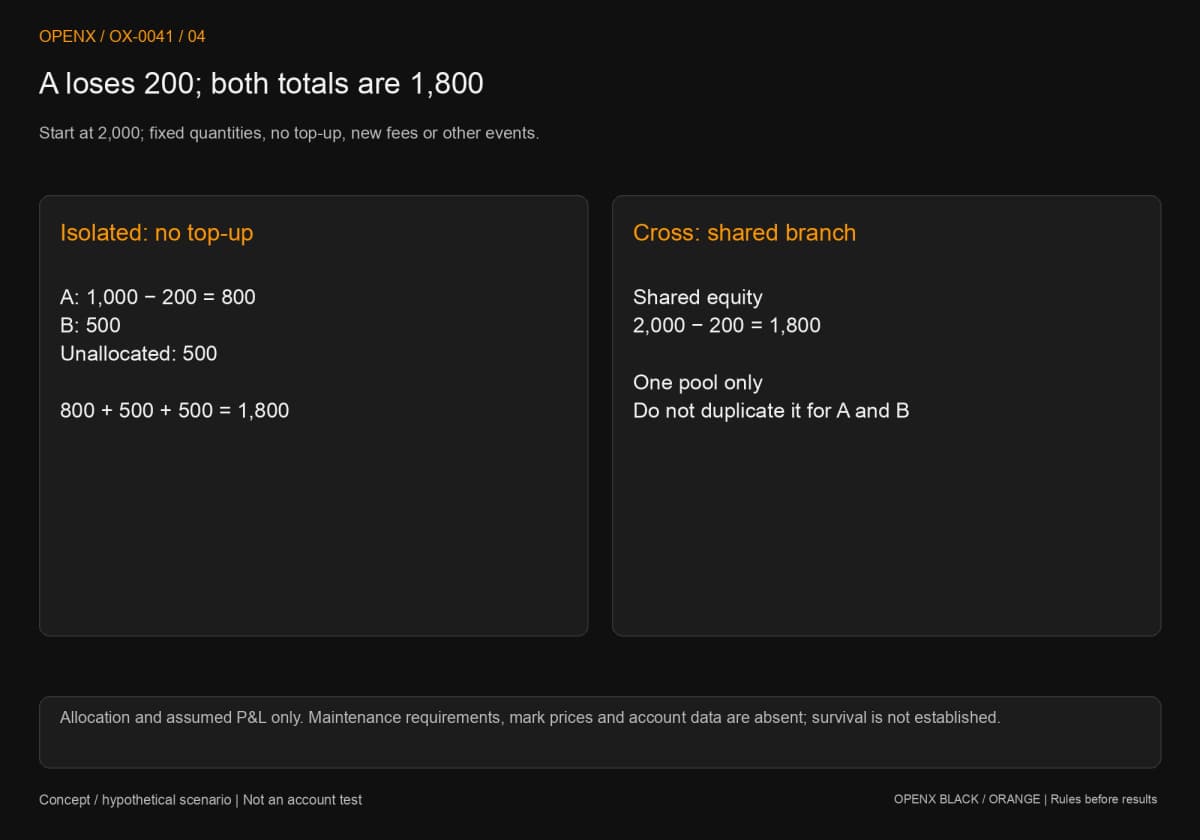
Step 3: a 300 USDT transfer is not a recovery
In the top-up branch only, transfer 300 from the unallocated 500 to A. A's allocation rises from 1,000 to 1,300. Its unrealized loss remains 200, leaving illustrative equity of 1,100. B stays 500 and unallocated funds fall to 200. The total remains 1,100 + 500 + 200 = 1,800. Only allocation changes.
Calling A's increase from 800 to 1,100 a 300 USDT profit breaks the ledger: the money came from unallocated funds. Saying A is still supported by only 1,000 is also inaccurate after the transfer. Retain original allocation, cumulative transfers and current equity to see how much support you have added.
The example assumes a manual 300 USDT transfer. If AMR is enabled in reality, record the platform's actual transfer time and amount. Do not substitute 300 or treat it as an AMR ceiling. Recheck support and risk when available funds or settings change; an earlier screenshot may no longer apply.
Step 4: B loses 300, and the shared pool is counted once
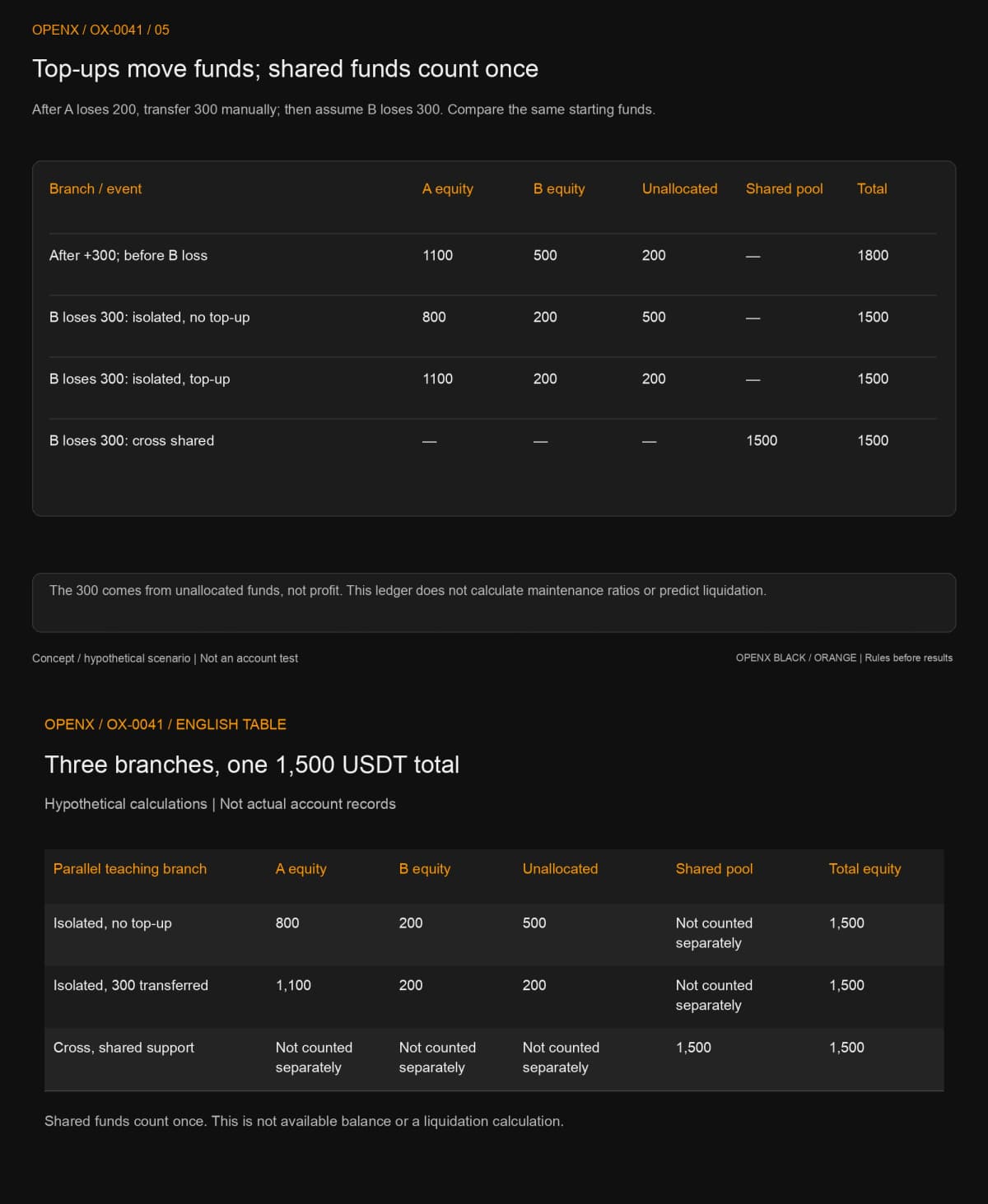
The second fixed event is a 300 USDT unrealized loss on B. A still has a 200 loss, with no new fills, withdrawals or fees. Each branch now has total equity of 2,000 − 200 − 300 = 1,500. Reconcile the columns rather than counting the same money twice.
| Parallel teaching branch | A equity | B equity | Unallocated | Shared pool | Total equity |
|---|---|---|---|---|---|
| Isolated, no top-up | 800 | 200 | 500 | Not counted separately | 1,500 |
| Isolated, 300 transferred | 1,100 | 200 | 200 | Not counted separately | 1,500 |
| Cross, shared support | Not counted separately | Not counted separately | Not counted separately | 1,500 | 1,500 |
This does not establish that cross margin will rescue a position. Sharing may give a position access to more supporting funds, while another position's loss or collateral change can affect the whole account. Whether maintenance requirements are met depends on contemporaneous eligible equity, positions, fees and risk formulas. A 1,500 total is not proof of safety.
The no-top-up branch retains 500 unallocated because that is its chosen funding boundary. It is not a promise that every isolated account can never use other funds. Enabling automatic replenishment, transferring again or trading creates a new version; the old row no longer describes the account.
Step 5: reconcile closing records without inventing a liquidation
For a final separate settlement exercise, assume both positions close fully at the losses above. Add hypothetical total trading fees of 3 USDT, with no funding or other events. The ledger becomes 2,000 − 200 − 300 − 3 = 1,497. The 3 is an exercise amount, not an observed fee rate or historical debit. The 1,497 is not automatically an available or withdrawable balance.
For actual reconciliation, establish closing fills and remaining quantities first, then record actual fees and transfers. A margin top-up is not profit, and releasing committed margin is not a second source of income. The trading journal fields and templates keep transfers, fills and settlements as different events, so each amount is counted once.
Without contemporaneous mark prices, maintenance requirements and account reports, this ledger cannot reveal which position was liquidated. Mark price is a valuation and risk reference, distinct from the last traded price. Bybit's FAQ — Order Execution and Liquidation, dated September 25, 2026, distinguishes isolated mark-price conditions from cross-margin account-risk conditions. Do not collapse both into one universal liquidation price.
Before switching modes, check orders and risk requirements
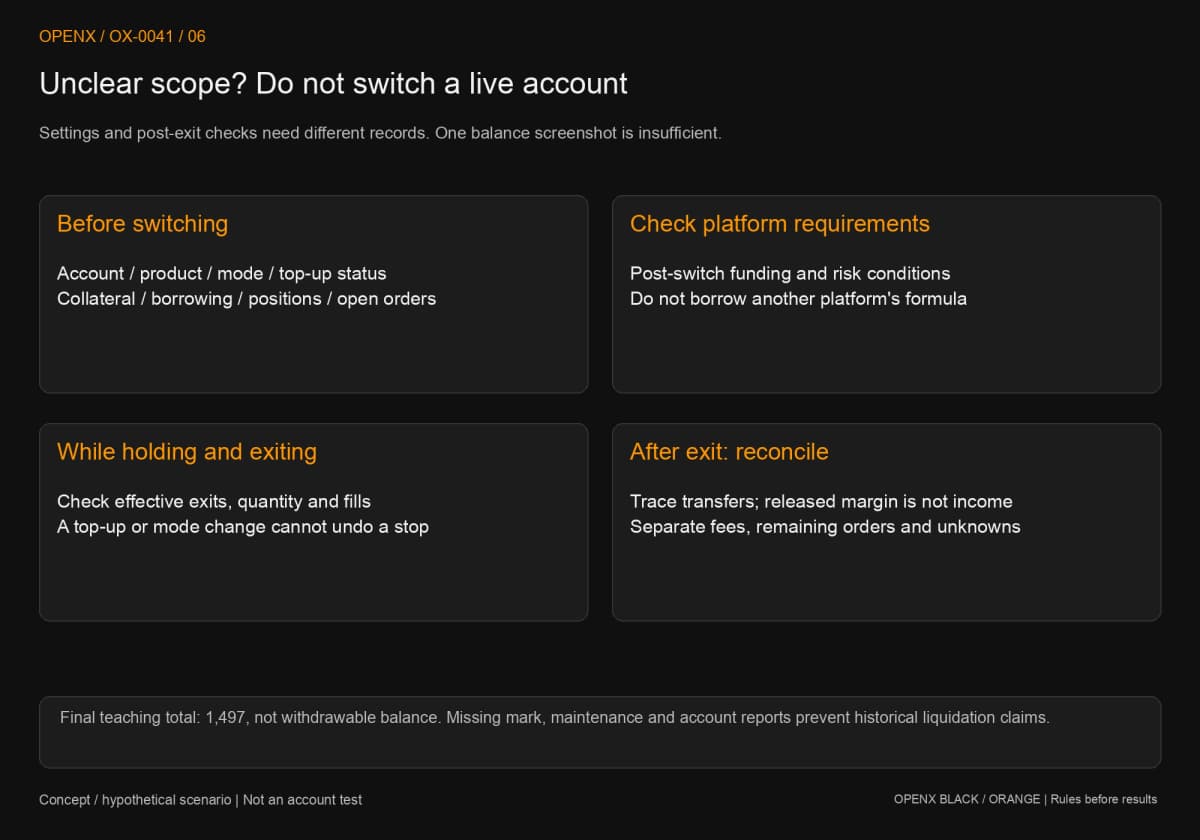
Check the entire affected scope before switching. A mode change is not an emergency button for a trade approaching its stop. Verify account and product, current mode, replenishment settings, collateral, unfilled orders, positions and possible borrowing, then the post-switch funding and risk requirements. If a field is unclear, resolve it before changing a live account.
For example, Bybit's mode documentation lists borrowing, options, sufficient assets and post-conversion position-risk conditions for moving from cross to isolated. An available menu option does not guarantee permission to switch. The cited OKX page says open positions cannot switch between cross and isolated within its stated product and user scope; do not transplant Bybit's conversion conditions into that rule. Actual availability depends on your product, account state and current interface.
Do not compare risk ratios solely by their size. Platforms can define them differently, including opposite directions of increasing risk; check formulas and thresholds first. Strategy stops also require separate checks of trigger source, order type and execution status. Changing mode or moving funds cannot undo an exit that has already occurred or prove a stop will fill before liquidation.
Connect funding boundaries to your trade records
Every transfer needs a source, every branch must reconcile to its total, and a shared pool appears only once. Reproduce the sequence 2,000, 1,800, 1,500 and 1,497, with separate columns for unallocated funds and transfers. These calculations explain allocation, not platform maintenance ratios, actual liquidation or withdrawable funds.
Next, read futures liquidation: mark price, maintenance margin and stop-loss orders. It develops the platform-risk thresholds. Here, the task is to explain funding relationships without inventing a precise historical liquidation point from incomplete information.
This article is for learning product mechanics and practicing a ledger, not investment advice. Top-ups, cross-margin sharing, fees, collateral and execution conditions can affect actual losses. Choosing a mode does not guarantee a maximum loss per trade.