Stablecoin reserves support a token’s value and redemption arrangements; the headline total is not enough. Circle’s September 2026 USDC Reserve Report shows why you must align dates, circulation definitions and asset scope before reading the accountants’ opinion. Full backing at a specified time does not mean every asset is cash or every holder can redeem immediately. You should be able to reconstruct the same-date denominator and asset total; if dates or scope do not align, pause the comparison.
A report says assets exceed the tokens in circulation. What next? If we turn that sentence into “safe” and stop there, we miss the dates, asset details and usage restrictions. The problem is not necessarily that the numbers are unreliable. They may simply answer a narrower question than the one we have in mind.
This guide first explains how to read the document, then follows one historical USDC report from circulation to total reserves. USDC is a dollar-referenced stablecoin in Circle’s issuing system. You do not need to finish an accounting course first, but you do need to know which column each number comes from and which steps you cannot skip.
Reserve figures describe assets, not guaranteed receipt of your payment
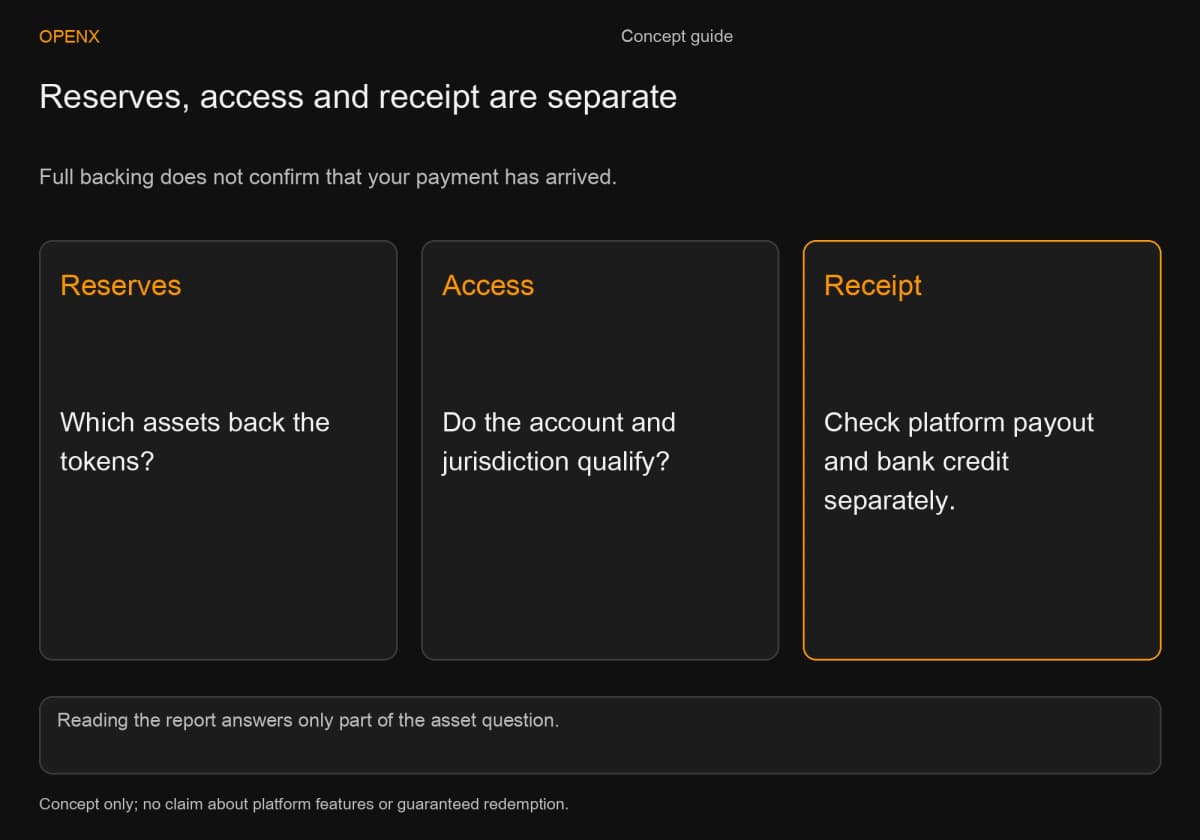
A reserve report mainly helps you understand which assets back the tokens. It does not guarantee that each payment you make will arrive. A dollar-referenced stablecoin generally aims for a value near one dollar per token; reserves may include bank deposits, Treasury securities and other permitted assets. Fair value is the value measured under the report’s stated standards, not a guarantee that selling everything immediately would put the same amount of cash in the bank.
If holding tokens, selling them on a market and redeeming directly still seem interchangeable, start with stablecoins and redemption routes. They are related, but they are different commitments. Reserves are part of the issuing system. Whether your platform permits a withdrawal and whether the receiving bank accepts the transfer are separate conditions.
I find it more useful to put aside the question of which token is safer at first. Ask what this document actually covers: which legal entity, which moment, which figures and which management assertion the accountants address. Only after those pieces align is a ratio worth calculating.
Read the dates, entity and accountants’ opinion first
The measurement date, signing date and today are different times
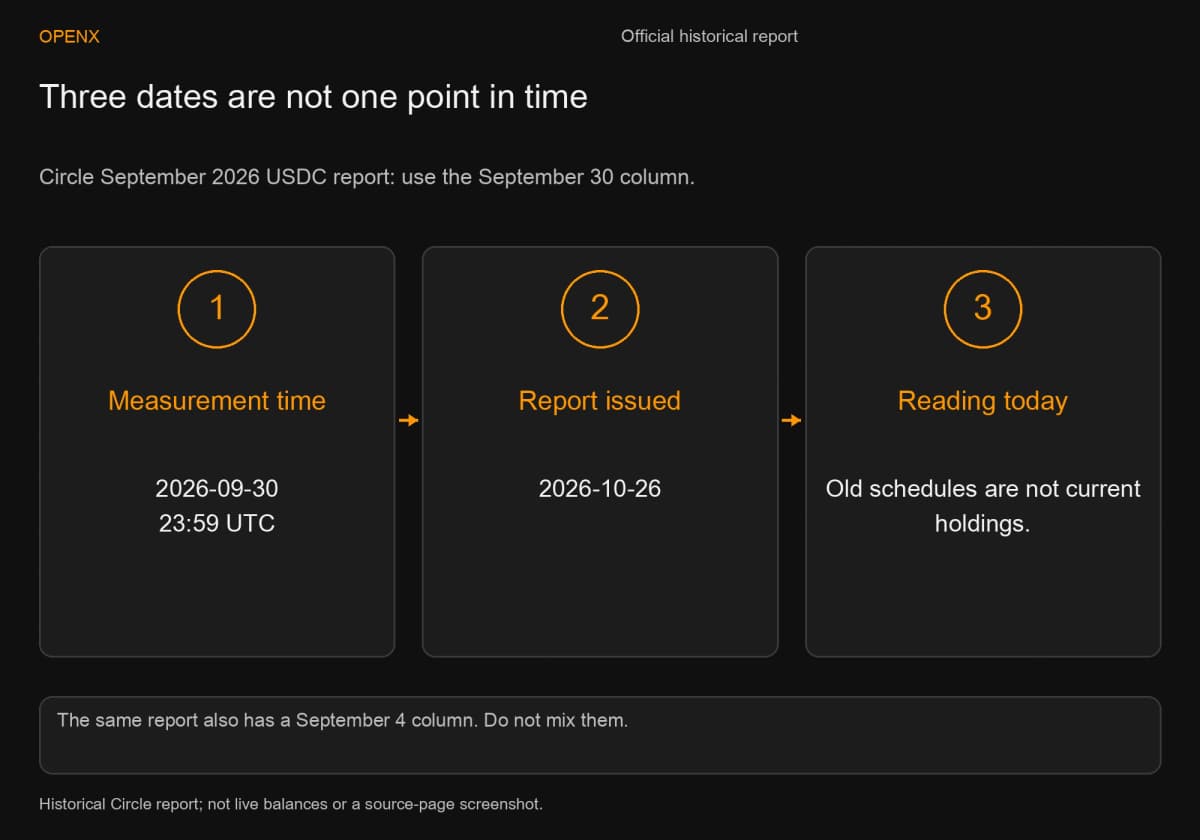
The measurement date tells you when the figures apply, the signing date tells you when the report was issued, and the reading date is when you open it. You cannot automatically attach the last date to the earlier assets. Circle’s transparency page describes weekly disclosures and monthly third-party assurance. A weekly website update does not make every holding in last month’s report a holding as of today.
The example uses Circle’s September 2026 USDC Examination Report. It covers September 4 and September 30, both at 11:59 p.m. Coordinated Universal Time (UTC). The accountants’ report is dated October 26. We use the September 30 column throughout, not because the other column is worse, but to avoid mixing dates.
Identify the subject of assurance before focusing on the firm’s name
An attestation or assurance engagement reaches a conclusion about a defined subject against stated criteria. An examination should not be treated as an audit of complete financial statements simply because the terms sound similar in translation. This Circle report examines management’s assertion that, under the accompanying criteria, the fair value of assets held in the USDC reserve equals or exceeds the amount represented by USDC in circulation at the specified times. The accountants provide reasonable assurance: procedures obtain evidence sufficient to support a conclusion, rather than an absolute guarantee covering every future situation.
Tether International’s Financial Figures and Reserves Report as of September 30, 2026, with the accompanying BDO accountants’ assurance report, covers that entity’s assets, liabilities and stated criteria. It explicitly limits the work to that point in time and places the Notes outside the assurance scope. Appendices and notes can be informative, but being included in the same PDF as an accountants’ opinion does not mean every page receives the same level of assurance.
The two tokens have different issuing systems, usage conditions and reporting definitions. For background, see USDT and USDC in practice. Before comparing reports, align at least the legal entity, date and denominator. One issuer’s total liabilities cannot simply be treated as another issuer’s token circulation.
Reconstruct circulation and assets from one USDC report
This walkthrough has one task: recalculate the September 30, 2026 column, then write a conclusion that stays within the report’s scope. The figures come from the management assertion, definitions and asset schedules in the Circle report above. This is a historical document exercise, not a live balance check. Have a calculator ready and keep token quantities separate from dollar amounts.
Step 1: Fix the time instead of filling gaps with current website figures
Record September 30, 2026, 23:59 UTC and the report’s definition of USDC. Management lists 73,878,861,314 USDC in circulation and $73,956,687,701 as the fair value of reserve assets. Write down these two endpoints first, then work through the schedules to see how they are constructed. Do not stop at the large totals.
The same page also has a September 4 column. If you have today’s circulation page open as well, set it aside. Replacing the denominator with today’s figure would no longer produce the coverage ratio for this September report. When dates differ, find a complete set of figures for the same moment. If you cannot, do not make that comparison.
Step 2: Rebuild circulation before using on-chain supply as a denominator
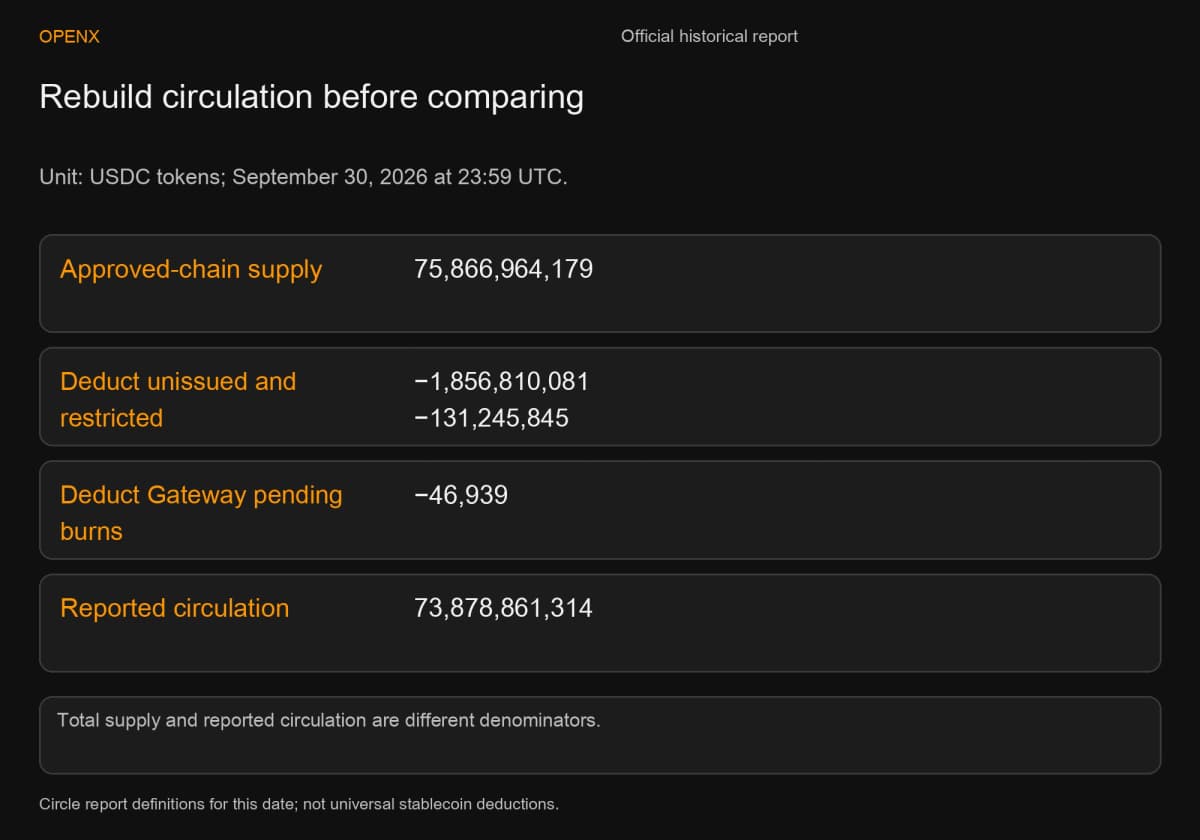
The report defines total supply on approved blockchains at September 30 as 75,866,964,179 tokens. That is not the circulation figure used in the headline comparison. The same document deducts 1,856,810,081 tokens allowed but not issued, 131,245,845 access-denied tokens, and 46,939 in Circle Gateway balances pending finalization of burns on chain. The calculation is 75,866,964,179 − 1,856,810,081 − 131,245,845 − 46,939 = 73,878,861,314 tokens, which reconciles to the headline figure.
Tokens allowed but not issued relate to technical implementation on certain chains; they cannot simply be counted as tokens already delivered to ordinary holders. Access restrictions relate to matters such as laws or valid legal orders. We are reconstructing this document’s definition. That does not mean every stablecoin should use these three deductions, or that excluded tokens have no remaining rights or legal questions.
Step 3: Keep the negative adjustment when calculating fund net assets
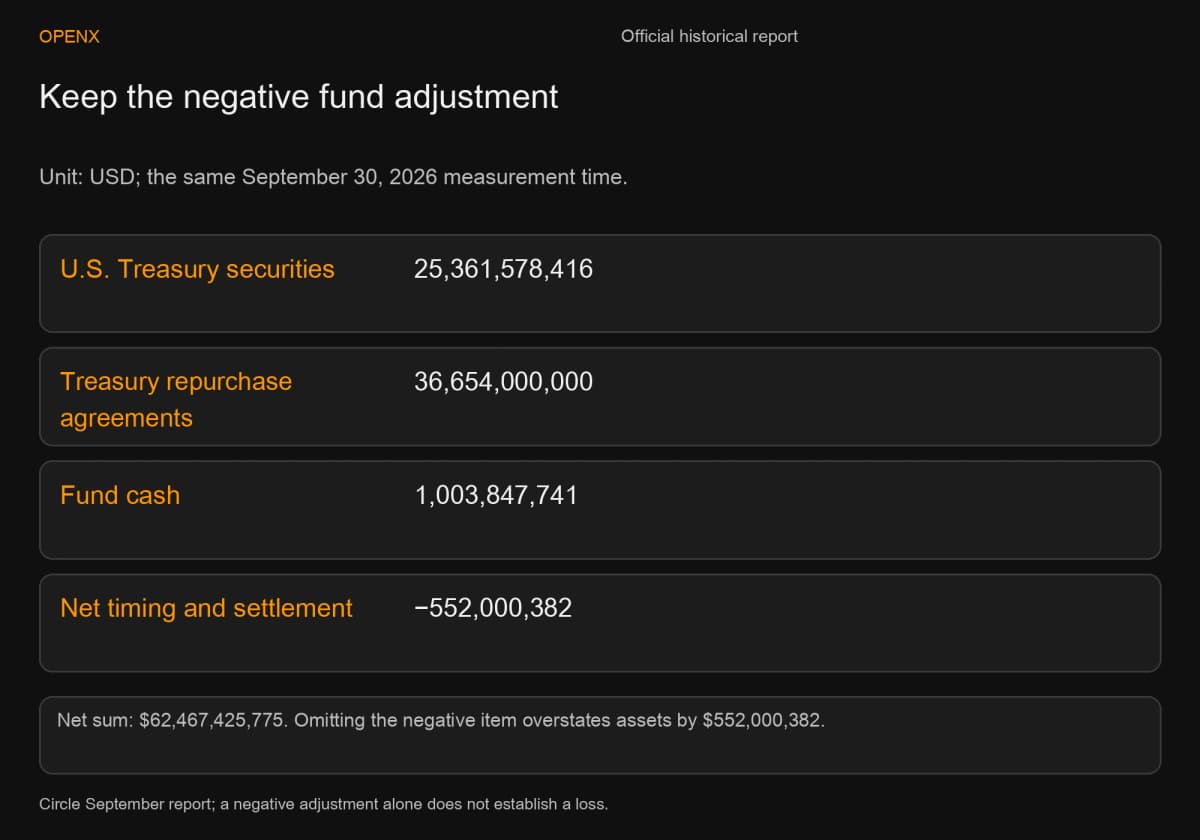
Next, open the September 30 Circle Reserve Fund schedule. The reserve fund is shown separately from reserve assets held elsewhere. The fund has $25,361,578,416 in U.S. Treasury securities, $36,654,000,000 in U.S. Treasury repurchase agreements, and $1,003,847,741 in cash. The net timing and settlement adjustment is negative $552,000,382.
The report’s notes describe the repurchase agreements as overnight cash lending overcollateralized by U.S. Treasury securities. This is not another name for a bank cash deposit. Without trying to rank these categories for safety, keep their original signs: 25,361,578,416 + 36,654,000,000 + 1,003,847,741 − 552,000,382 = $62,467,425,775. That matches the fund’s asset total.
Do not delete the negative amount because it looks like a temporary difference. The report explains that adjustments involve bank cutoffs, transfers between entities, securities settlement, interest receivable or payable, and unrealized gains or losses, among other timing and settlement factors. A minus sign alone does not establish a loss or missing money. Conversely, adding only the three positive figures gives $63,019,426,157, overstating the reported fund net assets by $552,000,382. The difference is an omitted adjustment, not newly discovered reserves.
Step 4: Calculate other reserves separately, then reconcile the total
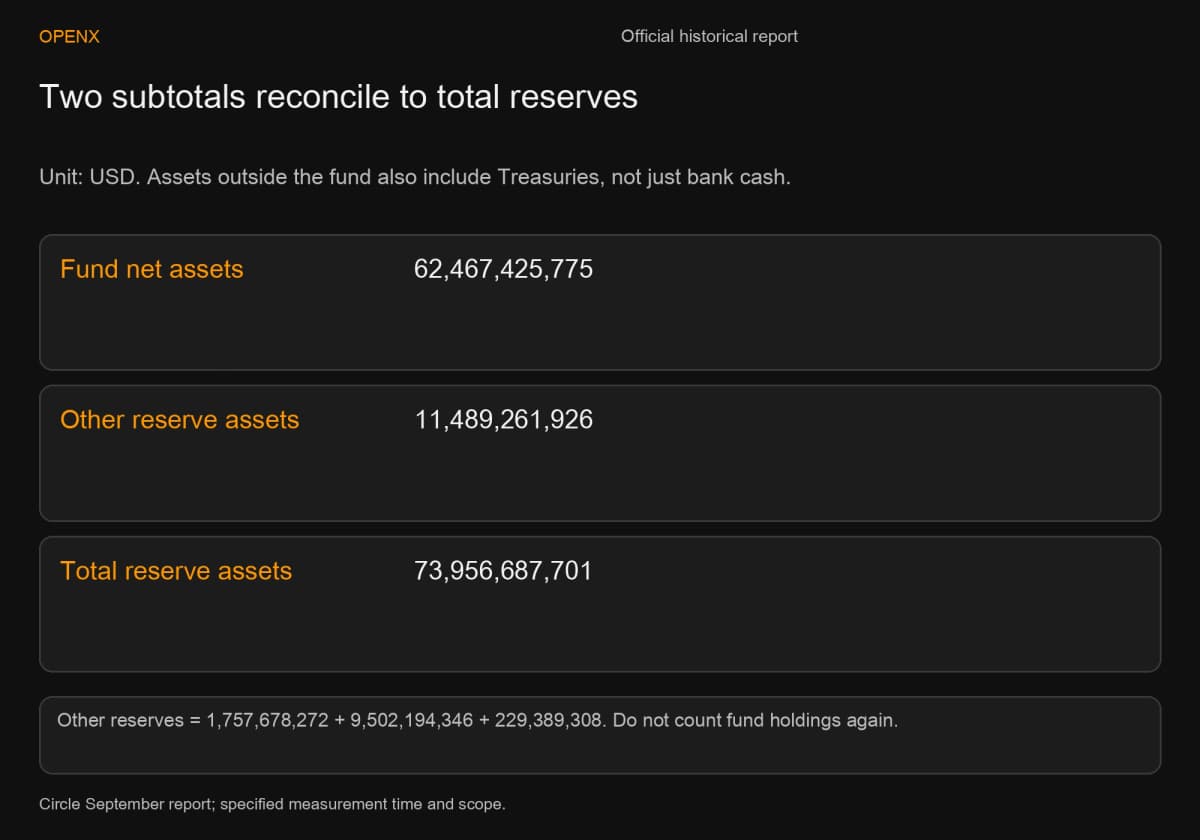
A separate September 30 schedule lists reserves outside the fund: $1,757,678,272 in U.S. Treasury securities, $9,502,194,346 in cash at regulated financial institutions, and a positive $229,389,308 net timing and settlement adjustment. Other reserve assets therefore total $11,489,261,926.
Now add the two subtotals: 62,467,425,775 + 11,489,261,926 = $73,956,687,701. That reconciles to the fair value of reserve assets in the headline table. Treasury securities also appear outside the fund, which is why “outside the fund” does not mean “all bank cash.” Similarly, adding the fund total and its underlying Treasury holdings again would double-count assets.
Step 5: Calculate the difference and ratio without changing units
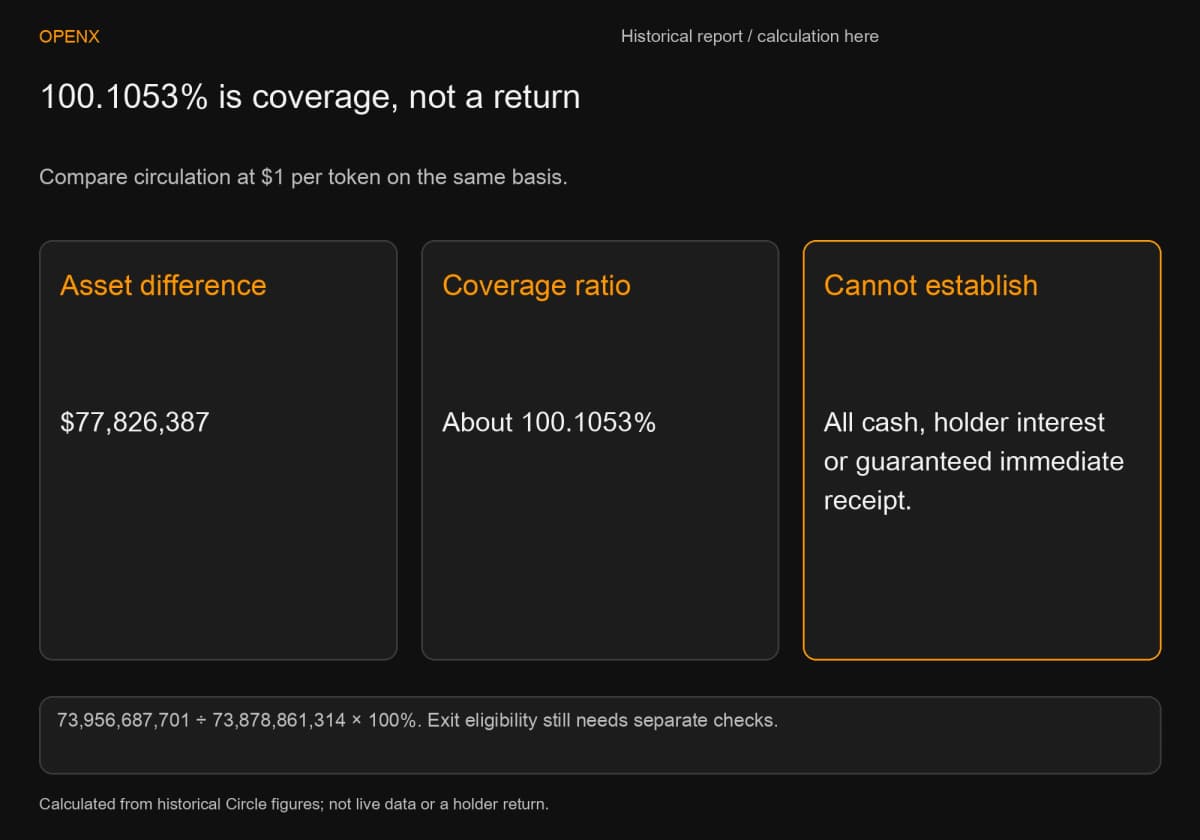
Subtract circulation valued at one dollar per token from total assets: 73,956,687,701 − 73,878,861,314 = $77,826,387. Dividing reserve assets by the circulation amount on the same basis gives a coverage ratio of about 100.1053%. This is a ratio calculated here from the report’s figures, not a separately promised rate of return.
The extra $77,826,387 cannot be allocated to holders as interest, nor is it a security deposit we have calculated for every redemption. Circle’s USDC Terms dated October 15, 2026 state that holders are not automatically entitled to interest earned on reserves. Those terms apply outside the European Economic Area (EEA); holders in the EEA need the applicable documents. Calculating coverage still does not complete your eligibility checks or payment process.
Step 6: State the conclusion and keep unanswered questions visible
You can now conclude that, under this report’s definitions and at its specified time, the fair value of reserve assets shown for September 30 exceeds the corresponding amount of circulating USDC, and the schedules reconcile to the total. You also know which deductions define circulation, how the fund and other reserves are separated, and which negative adjustment cannot be skipped.
You still cannot conclude that all the assets are cash today, that you can definitely redeem directly right now, or that the token can never move away from one dollar. These are not polite caveats added for appearance. The calculation never tested asset realization, market stress, your account eligibility or the actual status of outgoing and incoming payments. Each needs its own evidence.
What a completed report review still cannot establish
Read asset categories together with how quickly funds can be accessed. Bank deposits involve banks and access arrangements; Treasury securities involve maturity, price, sale or settlement; repurchase agreements require attention to tenor and counterparties. You cannot call every asset cash. Equally, a different asset category is not enough to declare redemption impossible without reading the report.
BDO’s opinion on Tether’s September report also highlights that valuations assume normal trading conditions. They do not reflect unexpected or extreme market conditions, or delays in realizing value when major custodians or counterparties face liquidity shortages. These scope statements are more useful than remembering only the accounting firm’s name. They identify questions that remain open; they do not support an unlimited conclusion about an entire company from one report.
Another common mistake is confusing issuer reserves with custody at a trading platform. Understanding an issuer’s report does not establish that a particular platform fully safeguards your account assets, permits withdrawals, or that your bank has credited a transfer. Issuer documents, platform account records and bank statements answer different questions.
A further mismatch is substituting published minting and burning flows for closing reserve balances. Flows describe what happened during a period; balances describe what remains at a point in time. Large redemptions this week cannot simply be deducted from last month’s asset total to announce a shortfall today. Explaining the change also requires corresponding issuance, asset movements and closing figures on the same basis.
If you share a report’s findings, preserve the original amounts, units and dates rather than posting only a coverage ratio. Others should be able to tell whether a number is dollar assets, token quantities or a percentage calculated here. Precision means making the comparison clear, not displaying the most decimal places.
Keep a method for the next report, not a safety ranking
Reuse the same record for the next report: entity, measurement time, signing date, circulation definition, asset schedules, subtotals and adjustments, accountants’ conclusion and limitations. Enter the new figures each time rather than changing only the year in a heading. If sources are incomplete or dates do not align, record that a comparison could not be made.
After reserves, the next question is usually how you can exit. Continue with stablecoin redemption and market selling to separate direct-redemption eligibility, market fills, fees and usable bank receipts. A report can prevent an unsupported inference. It cannot remove the checks that follow.
This article is an educational walkthrough of historical documents, not investment or legal advice. Data and terms change; the example is neither a live reserve statement nor a guarantee of future redemption.