USDT belongs to Tether’s issuance system; USDC belongs to Circle’s. Tether’s “Fees” and Circle’s “Circle Mint” describe different access conditions: Tether’s direct acquisition or redemption minimum is $100,000, while Circle Mint serves institutions, not individuals. Reserve disclosures and conversion rules also differ. If the recipient accepts only one token, exclude the other; if both are accepted, compare the total cost of delivering the same net quantity. There is no universal winner in USDT vs USDC, and neither token is a dollar bank deposit.
If you need to pay 500, does USDT’s lower unit price necessarily make it cheaper? Before buying, check how the payment works. A platform may deduct its withdrawal fee from the tokens you send, and the recipient may accept only one asset. Buying 500 on a screen does not mean the recipient receives 500. A cheaper quote may even describe a route you cannot use.
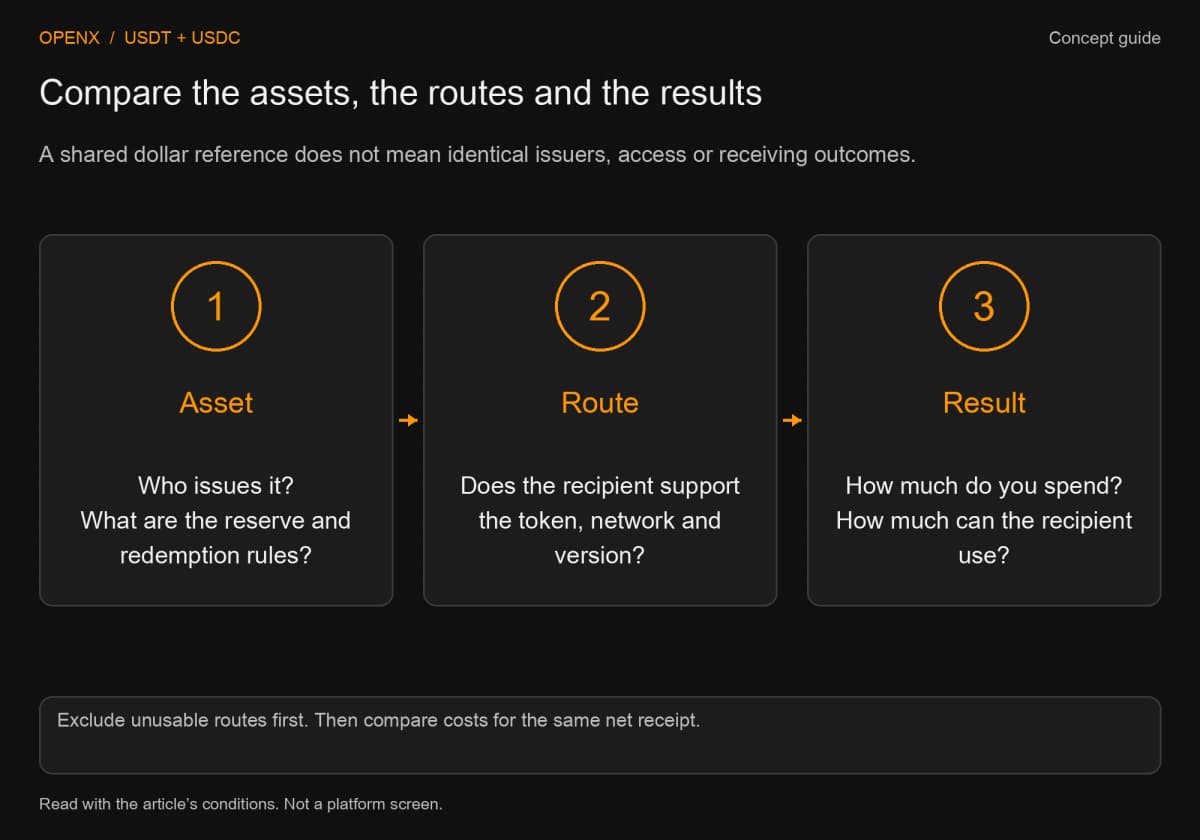
I would separate “How do these assets differ?” from “Can I complete this payment?” We will first explain issuance, reserves, conversion and token versions, then compare two routes for delivering a net 500 tokens from the same $510 budget. You will see how to make the choice and when to stop, rather than force a winner.
Separate three questions when comparing USDT and USDC
Compare the asset, the conditions of use and the outcome separately. Issuance arrangements and reserves explain what you hold; the platform and receiving service determine whether a route is available; actual charges and confirmation establish whether the task is complete. If holding tokens, selling on a market and holding a bank deposit are still unclear, start with stablecoins and redemption routes, then return to the comparison.
The issuer and reserve disclosures determine what you need to read
USDT belongs to Tether’s issuance system, while USDC belongs to Circle’s. Both are dollar-referenced stablecoins, but they are not two names for a service provided by the same company. Issuance creates and delivers tokens under the issuer’s rules. Buying existing tokens on a market means buying from a trading counterparty. Owning the tokens does not automatically make you an eligible direct customer of the issuer.
Circle’s “Transparency & stability” lists reserve categories including bank deposits, short-term US Treasuries and overnight reverse Treasury repurchase arrangements, and describes weekly disclosures and monthly third-party assurance. Assurance gives an accountant’s conclusion on a defined subject and scope; it does not establish that every risk has undergone a comprehensive audit. Tether’s “Legal” terms dated February 26, 2026 define reserves as cash, cash equivalents and other assets, potentially including loan receivables from affiliates. Its “Transparency” page separately provides circulation information and report access. These official materials were checked on November 7, 2026.
First align the entities, asset categories and reference dates in the documents, then examine their conclusions. Faster circulation updates do not establish that every reserve item was re-examined at the same moment. Reports with different dates cannot simply be combined into a safety ranking for one point in time. This section establishes how to approach the comparison; a separate reserves article will examine reports in detail.
Market sales and direct redemption determine which routes you can use
A market sale finds a counterparty at a trading venue. Direct redemption returns tokens under an issuer’s rules to receive fiat money—government-issued currency. Eligibility and costs differ. A $1 target does not replace checking the channel, and an ordinary exchange account is not an issuer account.
Tether’s “Fees,” checked on November 7, 2026, lists a $100,000 minimum for direct acquisition or redemption and a redemption fee of the greater of $1,000 or 0.1%. These are Tether’s direct-service conditions, not the minimum size of every USDT trade on a platform. Meeting the amount requirement also does not establish account or jurisdictional eligibility.
Circle’s “Circle Mint” product page says this issuance and redemption service is for institutional customers and is not available to individuals. The “USDC Terms” updated October 15, 2026 also make direct redemption conditional on an eligible Circle Mint account and other requirements. Those terms apply to holders outside the European Economic Area; separate documents apply inside it. Individuals may still obtain or sell USDC through supported secondary markets, but that does not guarantee everyone direct dollar redemption with Circle.
A token name alone does not establish receiving support
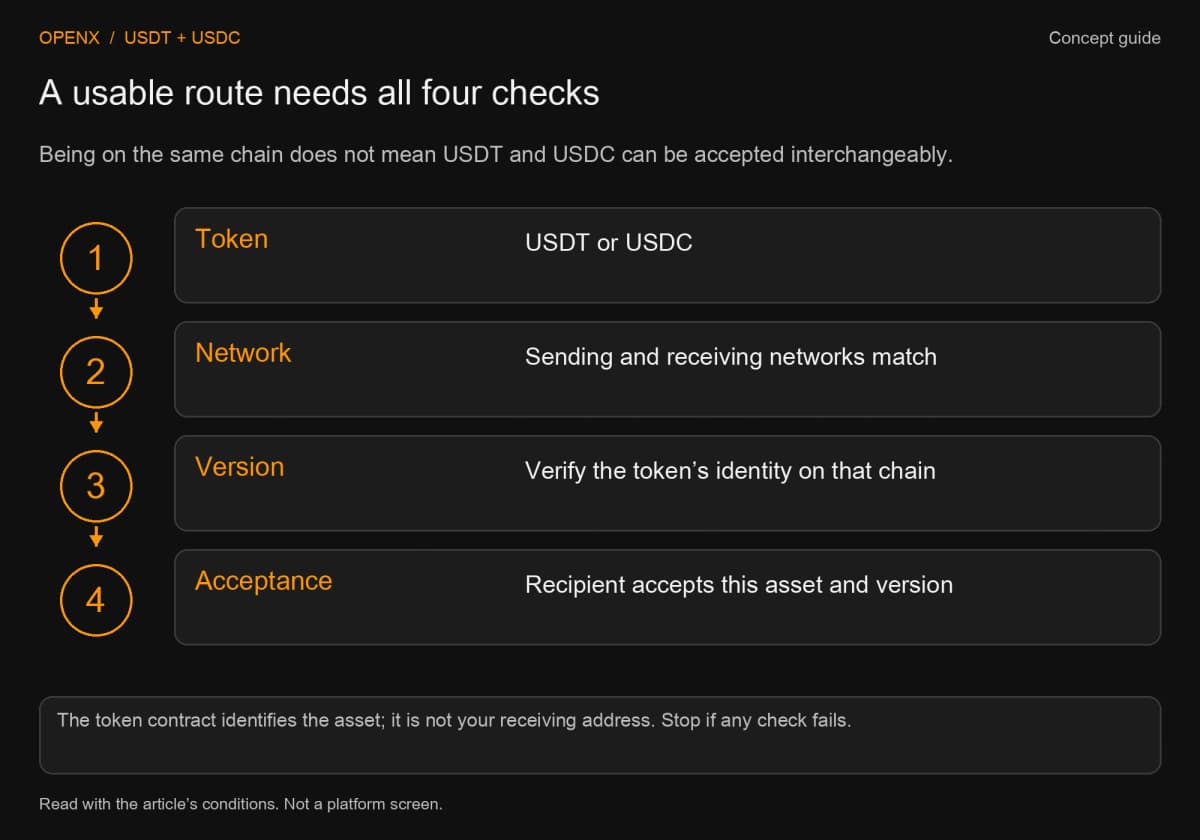
What the recipient accepts comes before your preferred token name. Check the token, network, version and receiving account together when comparing a payment route. If any one does not match, an attractive quote cannot make the route usable.
Confirm the token, network and version together
USDT and USDC can exist on different blockchains. A blockchain is the network recording transfers; a token contract address identifies the token on that network and is distinct from your receiving address. Tether’s “Supported Protocols and Integration Guidelines” and Circle’s “USDC Contract Addresses” provide official identification references. Support changes, so an old article’s network count is not a sufficient basis for a transfer.
A receiving platform supporting a blockchain does not establish that it accepts every similarly named token there. Native USDC is issued directly by Circle on that chain. Bridged USDC depends on cross-chain transfer arrangements and may not be issued directly by Circle on the receiving chain; the name alone cannot distinguish the two. Circle’s “Supported chains and currencies” specifically warns against depositing unsupported USDT or bridged USDC to a Circle Mint address. This does not make those assets unusable everywhere; it shows that a service has a defined asset scope. After identifying the asset, networks and transfer receipt checks explains the difference between on-chain completion and platform crediting.
Compare withdrawal deductions and gas separately
For each fee beside a quote, check its unit and where it is deducted. A purchase fee may be calculated in dollars, while a withdrawal fee may be deducted in tokens. Gas paid separately by a self-custody wallet is a network execution fee. Treating all three as one undifferentiated fee makes it easy to count a charge twice or miss it.
If you send from your own on-chain wallet, estimate costs for the current network and transaction. The name USDT or USDC does not determine a fixed charge; calculating gas fees distinguishes estimates from actual charges. The example below instead uses platform-withdrawal assumptions and fixes their meaning before comparing routes. These token withdrawal charges are not presented as inherent network fees of either asset.
Deliver a net 500 from $510: compare two routes continuously
This example compares the dollars needed for the same payment, not which token will rise in value. Suppose a platform M account already has $510 available. The recipient accepts verified USDT on Ethereum mainnet and Circle-native USDC there, and requires a net 500 of either token. Ethereum is the blockchain chosen for this example. Both candidate routes use the same network without changing chains. They are mutually exclusive alternatives under one budget, not instructions to buy both tokens: compare first, then execute one route.
Step 1: Fix the result and how fees are charged
Fix two requirements: the recipient must receive a net 500 and total dollar spending must not exceed $510. Platform M, every price and all fees are teaching assumptions, not current offers from OpenX or another real platform. No actual orders were placed. Assume the account, jurisdiction, trading and withdrawal eligibility requirements are satisfied, M supports both specified assets, the recipient deducts no further deposit fee and no additional receiving information is required.
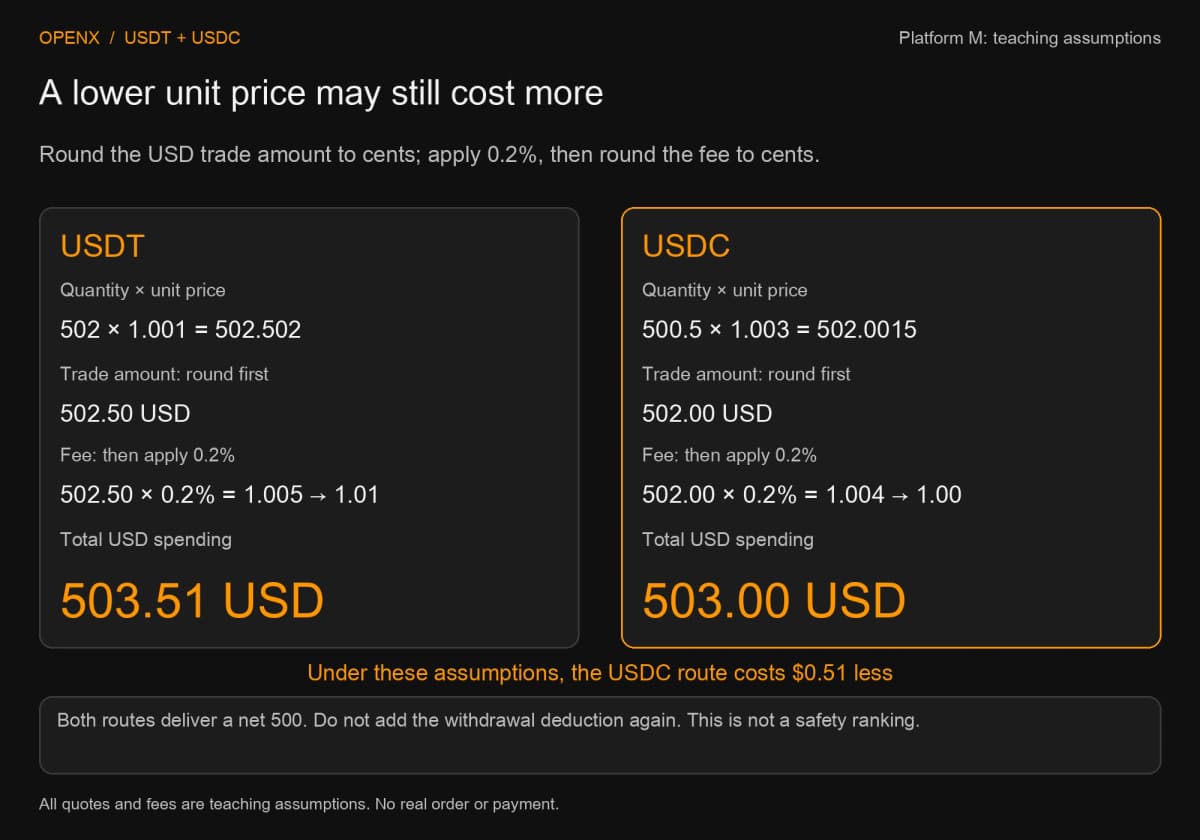
M allows purchases in increments of 0.1 token. Both routes have a dollar purchase fee of 0.2% of the trade amount. First round the dollar trade amount to cents, then calculate the fee on that rounded amount and round the fee to cents, with exact half-cent ties rounded up. Assume a USDT price of $1.001 and a USDC price of $1.003. These are purchase prices in dollars, not guaranteed future conversion prices.
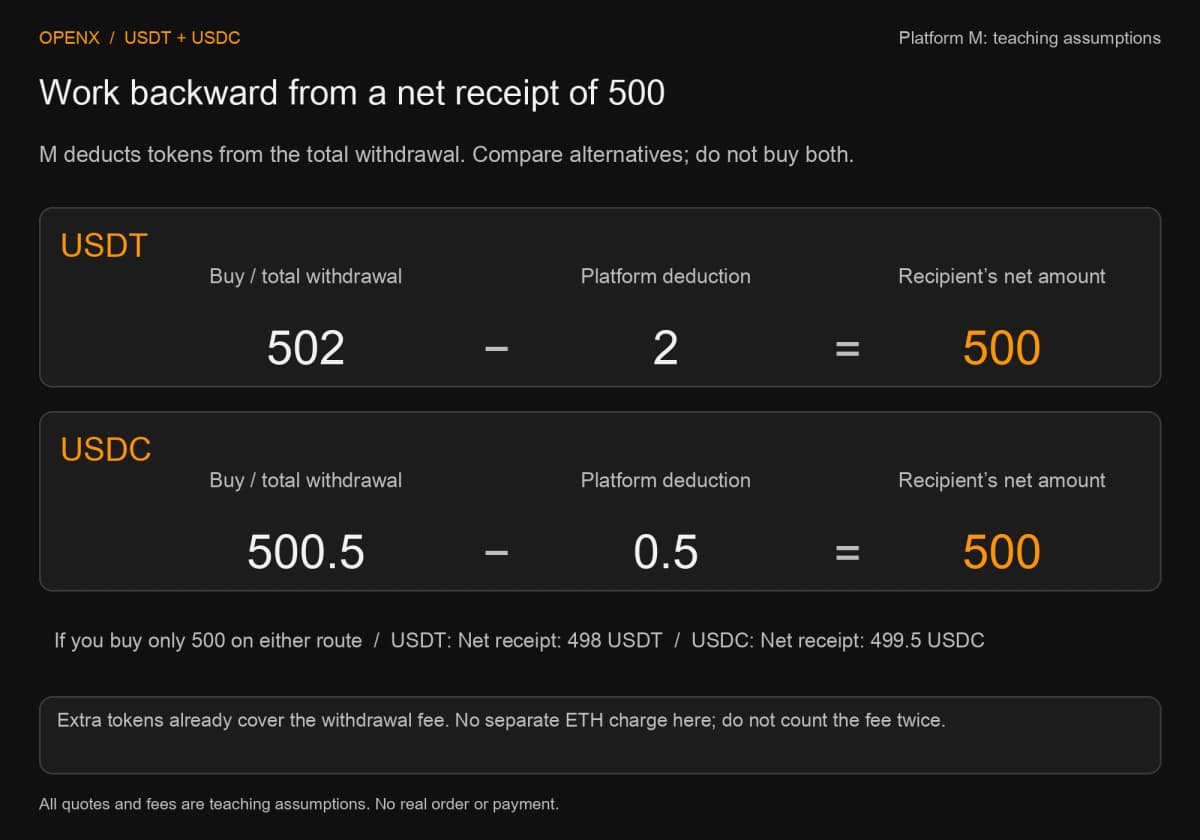
M deducts the withdrawal fee from the quantity entered: 2 USDT or 0.5 USDC. This fixed deduction represents the entire withdrawal charge M imposes on the user in this example; M does not separately deduct ETH or charge anything else. ETH is Ethereum’s native asset, used to pay network execution fees. The assumption is simply that the user pays no separate charge in that asset here. The entered quantity is the total token debit, and the screen must clearly show the recipient’s net amount. A real platform using a different deduction method requires a new calculation.
Step 2: Work backward from the recipient’s net amount
The USDT route requires buying 502 and entering 502 for withdrawal, leaving 500 after the deduction of 2. The USDC route requires buying 500.5 and entering 500.5, leaving 500 after the deduction of 0.5. Purchase quantities differ because the task is to deliver the same net quantity, not buy the same quantity on both routes.
If you buy only 500 on each route and withdraw under these assumptions, the recipient gets just 498 USDT or 499.5 USDC. A successful purchase on the trading screen would still leave the payment requirement unmet. That is why a fee comparison should work backward from what the recipient receives, rather than end at the purchase-quantity field.
Step 3: Calculate total dollar spending on the same basis
For USDT, the dollar trade amount is 502 × 1.001 = 502.502, rounded first to $502.50. The fee is 502.50 × 0.2% = 1.005, rounded up to $1.01, giving total dollar spending of $503.51. The 2 USDT withdrawal fee is already accounted for by buying two additional tokens. Do not convert that fee into dollars and add it to $503.51 a second time.
For USDC, 500.5 × 1.003 = 502.0015, recorded as $502.00. The fee is 502.00 × 0.2% = 1.004, rounded to $1.00, giving total dollar spending of $503.00. Again, buying 500.5 to deliver 500 already accounts for the 0.5 USDC withdrawal deduction; do not add it again.
Under these fixed conditions, both routes fit the $510 budget, and USDC costs $0.51 less despite its higher unit purchase price. This shows how the stated fees and quantities affect spending in this case, not that USDC is always cheaper. A different platform, amount or deduction method can change the result.
Step 4: Verify the conditions, then buy and pay based on actual fills
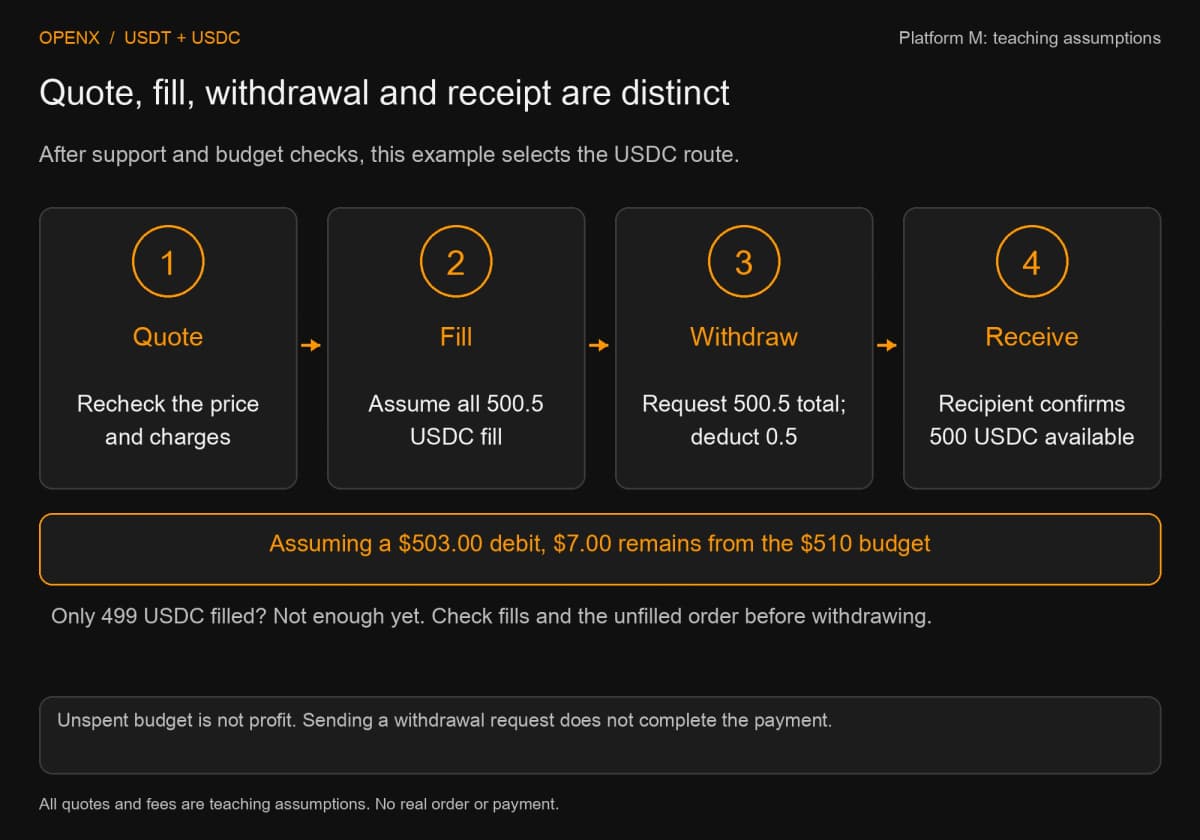
Before accepting the comparison, reconfirm that the recipient accepts both specified assets, withdrawals are available at M and the quantity and minimum-amount requirements are met. If the recipient changes to accepting only USDT, exclude USDC first. Saving $0.51 cannot justify sending an asset the recipient does not accept. Only when both routes are available does this example choose the cheaper USDC route, checking the quote and charges again before buying.
Assume all 500.5 USDC really fill and the actual average price and agreed fee calculation match the inputs exactly. Only then does M debit $503.00 and leave $7.00 in the account. After checking the available withdrawal balance, request a withdrawal of 500.5 in total. Record the payment as complete only when the recipient finally confirms 500 USDC is available. The remaining $7 is unspent budget, not trading profit.
If only 499 USDC fills, you have not bought the required 500.5. Do not record the full $503 as the actual charge or proceed with the original withdrawal plan. Check filled quantity, actual fees and the unfilled order before deciding whether to cancel or request a new quote. If a withdrawal has been sent but not credited, check the original request rather than send again because it is taking time.
Step 5: Reassess the route when the quote changes
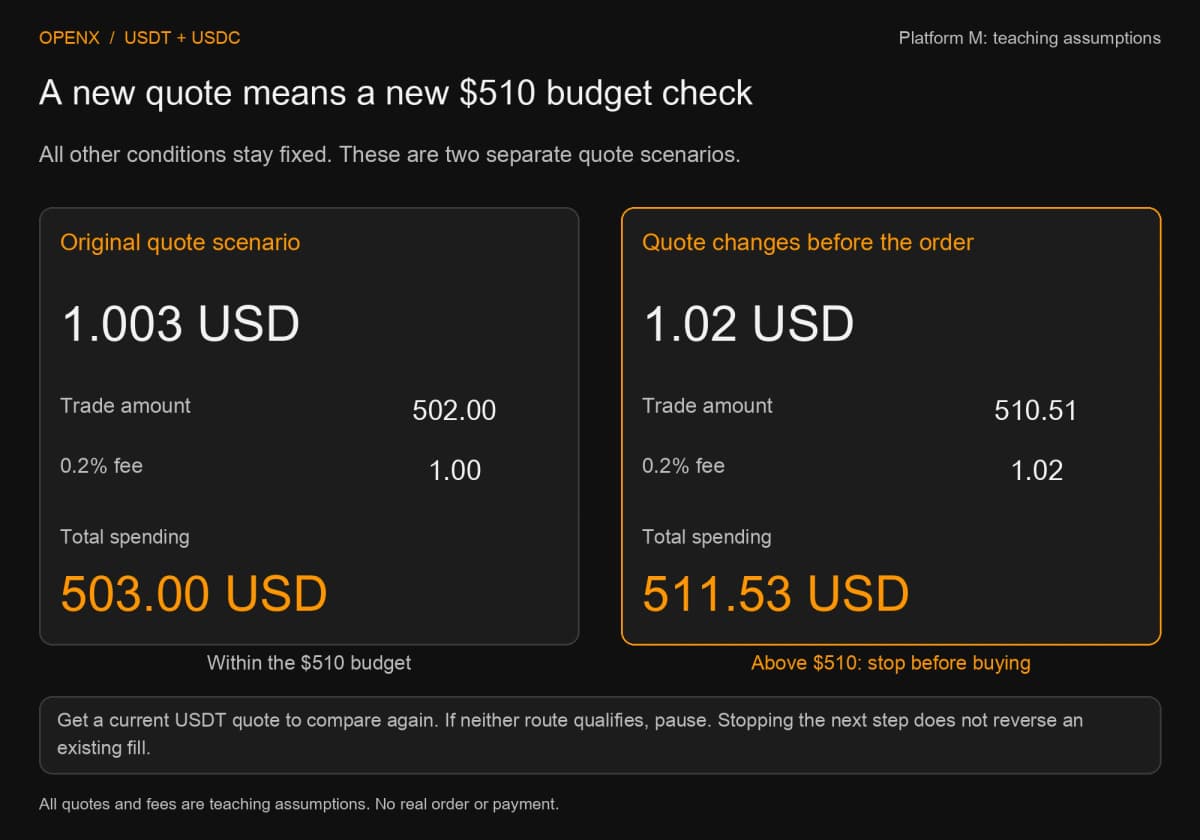
Consider another branch: all other conditions stay fixed, but the USDC quote rises to $1.02 before the order. Buying 500.5 now has a trade amount of $510.51. The 0.2% fee is 1.02102, rounded to $1.02, producing a total of $511.53—above the $510 budget. Stop this route before buying. An earlier $503 calculation cannot be carried forward to a changed quote.
You may compare USDT again, but you need a currently executable price and conditions, not an assumption that the earlier $1.001 still exists. If neither route qualifies, defer the payment and agree on another arrangement with the recipient rather than reduce the quantity and pretend it meets the net-500 requirement. This branch has no fill: $511.53 is the estimate for a rejected plan, not spending that occurred.
If receiving conditions change after you have bought, the asset remains in your account. Stopping the next step does not reverse the previous fill. Swapping or selling back is another trade, requiring fresh prices and fees. A useful comparison tells you where you can still stop before each confirmation point, rather than merely choosing between two names.
Long-term holding and a short-term payment need different answers
A payment comparison asks whether the stated conditions deliver the full amount and what it costs. Long-term holding also requires assessing issuance, reserves, custody and access restrictions. Saving $0.51 on one payment cannot replace that assessment. Conversely, preferring one disclosure approach cannot make an unsupported receiving route usable.
If a price deviates from its dollar target, identify the trading pair. A USDC/USDT quote is not each token’s price against dollars, and a discount may reflect liquidity or channel stress. Liquidity concerns the terms on which you can buy or sell when needed. Aggregate circulation alone cannot establish that one platform will fill your required quantity now.
Keeping assets on a platform depends on its custody and withdrawal arrangements. Moving them to your own wallet adds responsibility for managing keys and checking transactions. Neither custody method automatically gives tokens deposit insurance because they target the dollar. The October 15, 2026 version of Circle’s “USDC Terms,” applicable to holders outside the European Economic Area, states the absence of deposit insurance in its “No deposit insurance” section. Tether’s February 26, 2026 “Legal” terms also state that tokens have no government backing and are not covered by the deposit-insurance and related protections listed there. If yield is offered for holding tokens, check who pays it and how funds can be retrieved. Another product’s reward is not fixed interest inherent in the token.
Continue with the question you need to answer
First reproduce the two routes that deliver the same net 500 and make sure you can separate eligibility, quantities and dollar spending. Then explore the relevant topic. These follow-up articles are not complete, so their planned titles remain visible:
- Further reading pending | How to Read Stablecoin Reserves: Asset Composition, Examination Dates and Report Limits.
- Further reading pending | Stablecoin Redemption vs Market Sales: Eligibility, Fees and Receipt Conditions.
- Further reading pending | Understanding Stablecoin Depegs: Price Deviations, Liquidity and Historical Cases.
- Further reading pending | Native vs Bridged USDC: Contract Identification and Receiving Restrictions.
- Further reading pending | Where Stablecoin Yield Comes From: Rewards, Lending and Liquidity-Pool Risks.
This article is for education and scenario practice, not investment advice. No actual orders or transfers took place. Prices, fees, eligibility and support change; real operations require checking the conditions at the time, and payment or access to funds cannot be guaranteed.