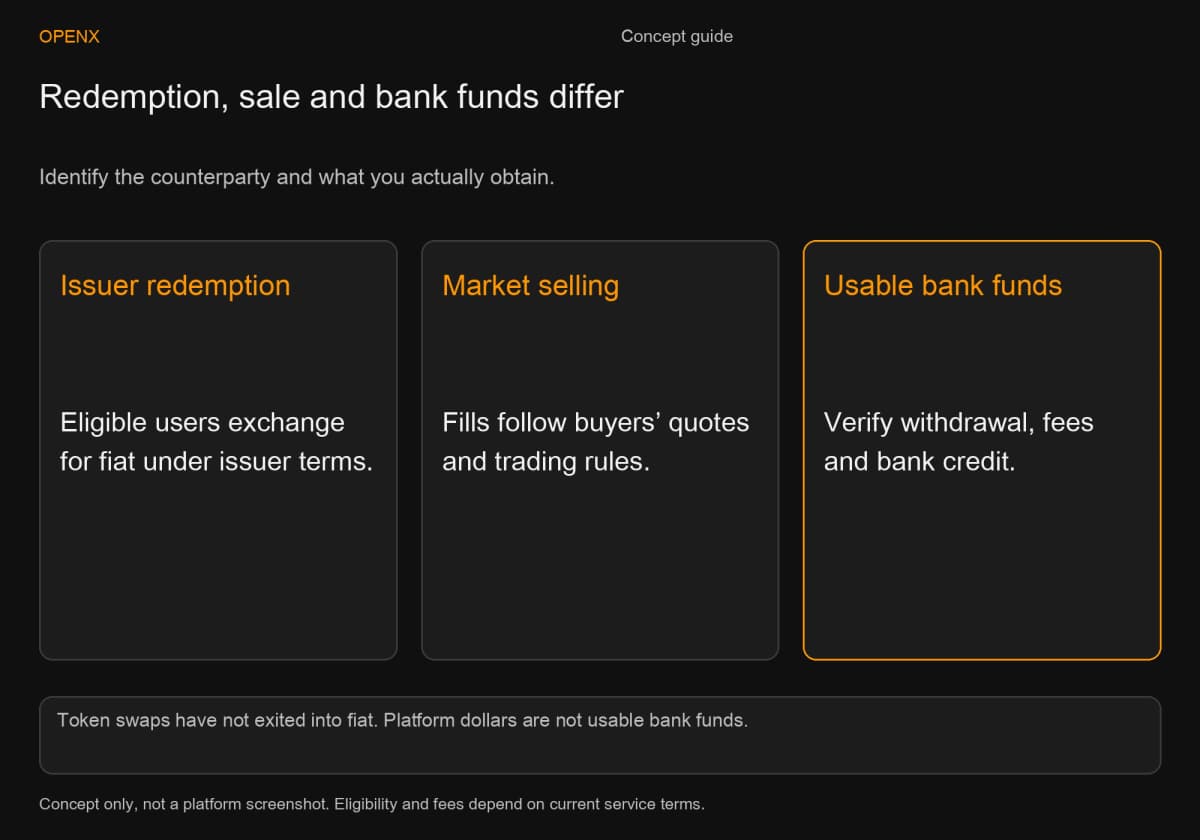
Stablecoin redemption means returning tokens for fiat under an issuer’s terms. Market selling executes at a venue’s bid prices, with different eligibility and fees. Tether’s Fees page lists a $100,000 direct-redemption minimum; Circle’s USDC Terms tie direct redemption outside the European Economic Area to an eligible account. Check usable channels first, then calculate usable bank receipts. If direct redemption is unavailable, check market selling and the bank route instead. Face value, platform dollars and bank receipts are different things.
Your screen shows 1,200 USDC, but your bank does not yet have $1,200. USDC is a dollar-referenced stablecoin in Circle’s issuing system; USDT belongs to Tether’s issuing system. The difference may be a buyer’s price, trading or withdrawal fees, or a bank transfer still being processed. Calling all of this “redemption” saves a word but makes it harder to know what to check when you need the money.
I would start by defining completion: which currency, which account and what minimum amount must actually arrive. This guide separates the issuer route from the market route, then follows the same 1,200 USDC through to usable bank funds. That makes the fees that affect the outcome easier to see.
Redemption goes through the issuing system; selling finds a market buyer
The main difference is who exchanges with you and under which conditions. Issuer redemption follows the issuer’s terms. Market selling executes at what buyers currently offer under the venue’s trading rules. If tokens and bank deposits still seem interchangeable, read stablecoins and redemption routes before choosing an exit path.
Face value, quotes and bank balances answer different questions
Face value is the pricing basis in redemption terms, a quote is a price available in the market, and a bank balance is money you can use after receipt. Fiat means government-issued currency, such as U.S. dollars. Holding a dollar-referenced token is not the same as holding dollars in a bank, and it does not let you skip account checks.
Circle’s USDC Terms updated October 15, 2026 explain that third-party prices may move away from one dollar. Even when an issuer uses 1:1 pricing under its terms, 1,200 tokens on the market cannot automatically be recorded as $1,200 received. Establish whether this transaction uses the issuer route or a market buyer willing to take the order.
Exchanging for another stablecoin is not an exit into fiat
Swapping USDC for USDT leaves you with another token. Selling USDC for a platform dollar balance takes another step, but the money remains on the platform’s books. This article’s endpoint is usable dollars in a bank account, so token exchanges, market fills and bank credit must be recorded separately. Only the last state completes this particular goal.
Check direct-redemption eligibility before face value
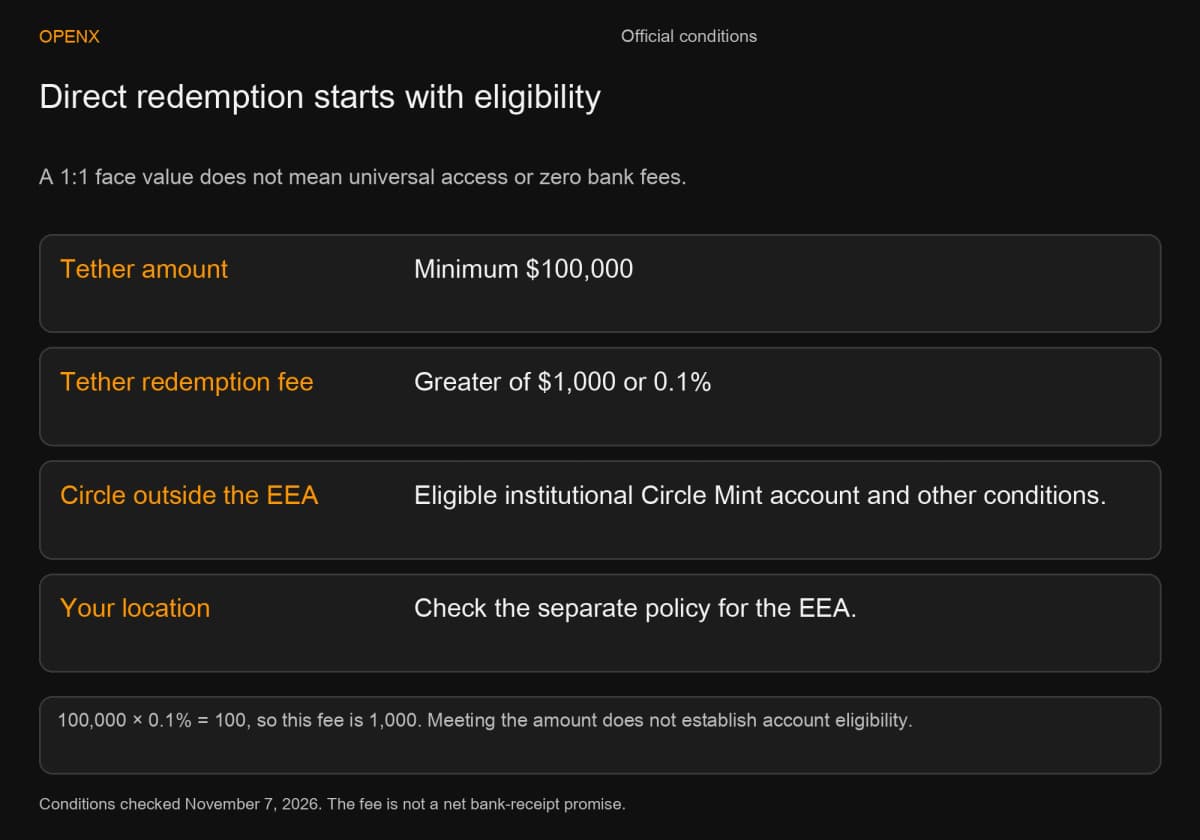
The issuer’s terms first determine whether you can use the route, then how it is priced. Meeting an amount threshold does not establish account, jurisdiction or review eligibility. The same company may also use different documents for different locations. Do not send tokens based on an online “1:1” claim before discovering that the receiving arrangement does not apply to you.
Read Tether’s minimum and fee together
As checked on November 7, 2026, Tether’s Fees page lists a $100,000 minimum for direct acquisition or redemption. The redemption fee is the greater of $1,000 or 0.1% of the redemption amount. On $100,000, 0.1% is $100, so the $1,000 fee applies. Subtracting that fee leaves $99,000; bank and other charges still need separate checks. This is a fee calculation, not a redemption procedure available to everyone.
Tether’s Legal terms updated February 26, 2026 still require users to satisfy the service conditions. The amount threshold is only one check; it cannot replace identity, bank-account and jurisdiction checks. Nor is this issuer fee the fee every platform charges to sell USDT. When comparing tokens, put USDT and USDC in practice back into the context of their actual channels.
For Circle, identify the account and jurisdiction first
Circle’s October 15, 2026 USDC Terms apply to holders outside the European Economic Area (EEA) and connect direct redemption with an eligible Circle Mint account. Circle Mint is an account platform for services including issuance and redemption. Section 1 of its Circle Mint User Agreement limits the service to eligible institutions, not a personal cash-out route automatically activated by owning a wallet. Holding tokens without opening or qualifying for the account does not grant direct dollar redemption with Circle.
The EEA has separate documents, including the MiCA Redemption Policy; rules for holders outside it should not simply be copied across. Circle’s official USDC/EURC redemption structure also lists service processing times separately from bank settlement times. This guide does not prescribe one route for every location. Check your location, account and current service conditions first; stop if availability is unconfirmed.
Follow 1,200 USDC through a market sale and withdrawal
The completion condition is at least $1,170 finally usable in the bank, not a successful sale message. Assume you already hold 1,200 USDC on platform M, which permits you to trade and withdraw dollars to your own USD bank account. All eligibility, rates, quotes and subsequent outcomes are teaching assumptions. No order or bank transfer was actually placed, and this is not a claim that OpenX offers these functions.
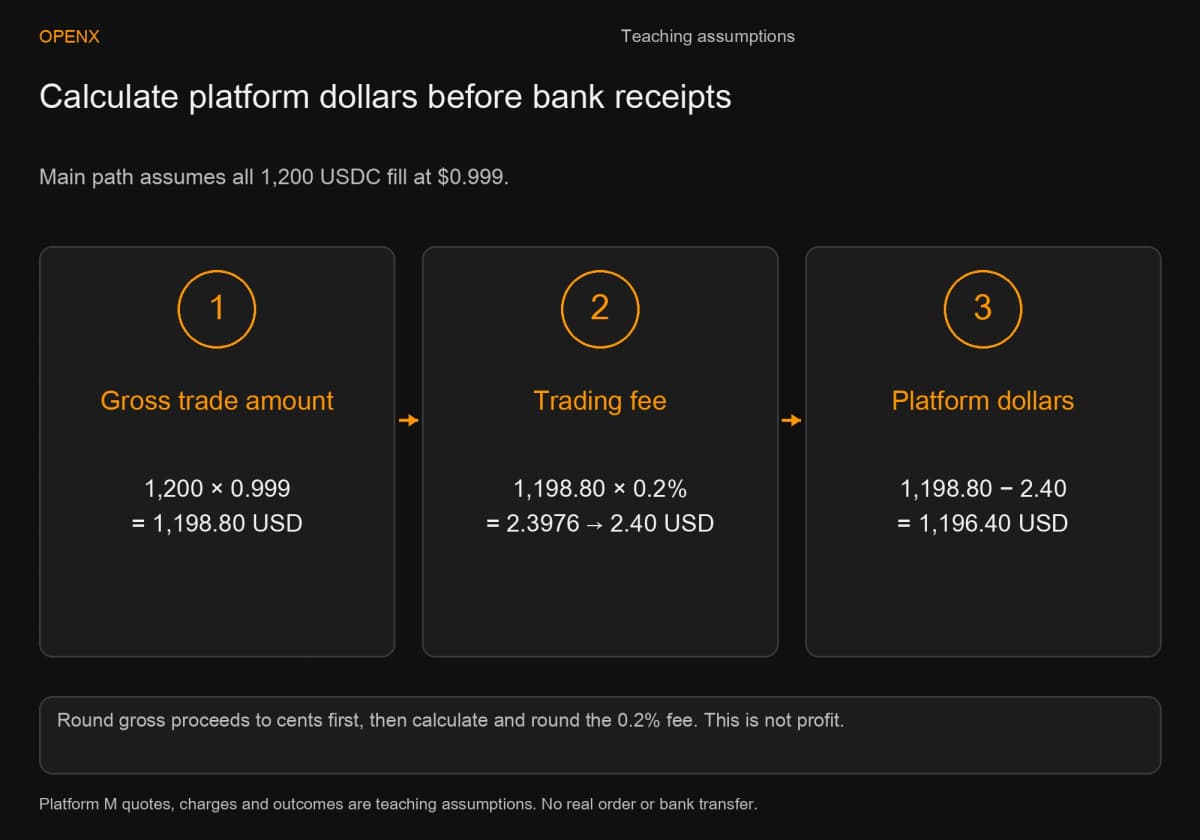
Fix the rules first: sell all tokens at an assumed $0.999 each. Round the platform’s gross dollar trade amount to cents, then charge a 0.2% dollar trading fee on that amount and round the fee to cents. The platform deducts a $10 withdrawal fee and the bank deducts a $5 receiving fee; neither is counted twice. Assume an initial platform dollar balance of zero, receipt in dollars and no additional currency conversion. Tokens already held on the platform do not create another assumed on-chain transfer or an invented gas charge. Gas is the network fee for on-chain operations.
Step 1: Confirm eligibility to sell and receive funds
This case does not transfer funds from an external wallet. First check whether the existing 1,200 USDC can be traded and whether dollar withdrawals, your own bank account and minimum amounts are supported. If the platform does not support your bank account, reject the route before trading. Being able to sell tokens does not establish that the resulting money can be withdrawn.
If your actual assets are in an external wallet, also check the token, network, version, deposit eligibility and required confirmations. Use networks and transfer receipt checks for that step, but calculate fees for your actual path. Do not apply this example’s lack of a new on-chain operation to a different route that requires a transfer.
Step 2: Calculate the platform dollars after the sale
Start with the fixed quote: 1,200 × 0.999 = $1,198.80 gross. The trading fee is 1,198.80 × 0.2% = $2.3976, rounded under the stated rule to $2.40. Subtracting it gives 1,198.80 − 2.40 = $1,196.40, the increase in platform dollar balance after a complete fill.
That $1,196.40 is not yet a bank receipt. It is not a profit figure either, because the example gives neither the original cost of acquiring the 1,200 USDC nor complete tax and funding costs. It answers only how many dollars this exit path is expected to leave after selling this batch. Define the question carefully so a neat calculation does not answer the wrong one.
Step 3: Estimate net bank receipts, then check actual fills
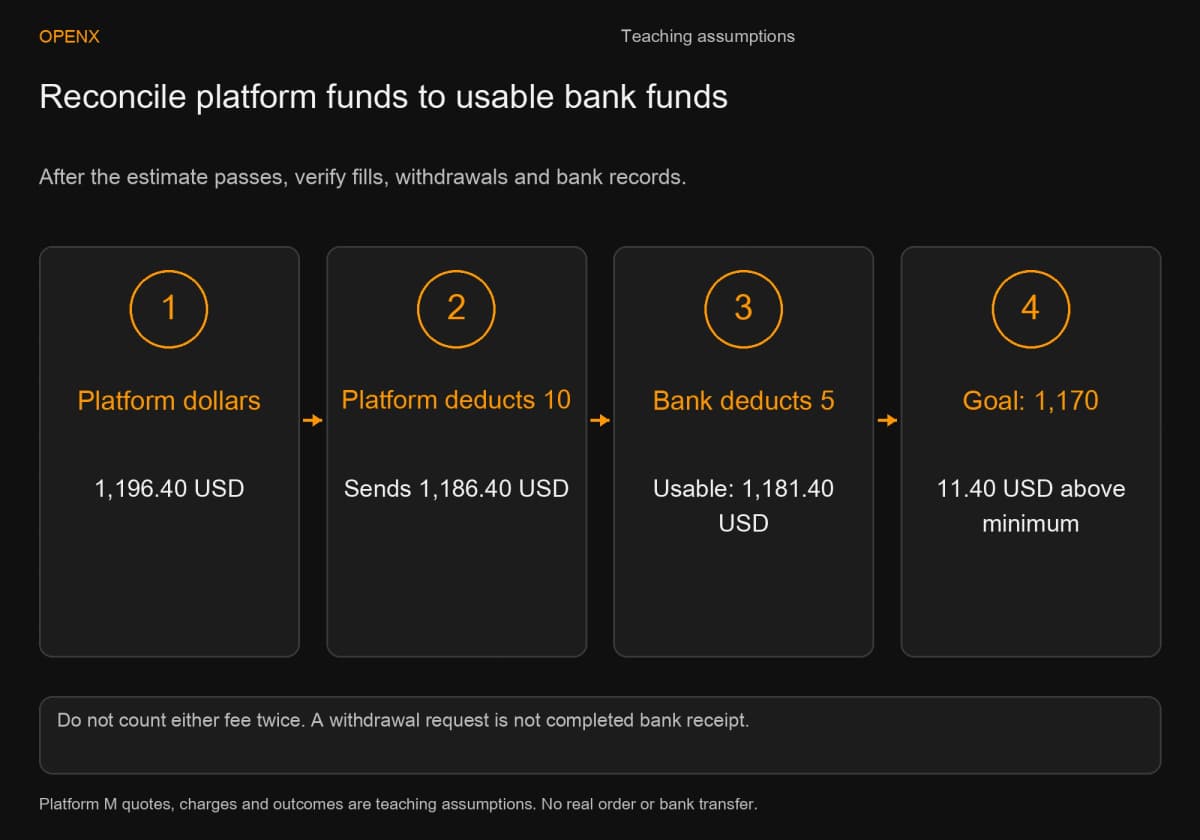
Continue with the fixed charges: 1,196.40 − 10 = $1,186.40 expected to leave the platform; 1,186.40 − 5 = $1,181.40 expected at the bank. This is $11.40 above the preset $1,170 minimum, so this estimate passes the amount condition. A fee absent from the assumptions is not known to be zero. Check missing charges before acting; an incomplete estimate cannot approve the route.
Even when the estimate passes, placing an order is not completion. A limit order specifies an acceptable price but does not guarantee a full fill. The main path separately assumes that all 1,200 USDC fill at $0.999 and the trading record actually deducts $2.40. Verify filled quantity, execution price and the charged fee first. Then request a withdrawal from the $1,196.40 actually obtained rather than carrying a pre-order estimate forward as if it were final.
Step 4: Confirm platform dispatch and usable bank funds separately
The main path further assumes that the platform deducts $10 and records $1,186.40 sent, then the bank deducts $5 and shows $1,181.40 available. Reconcile the order-fill record, platform-withdrawal record and bank-credit record before marking this exit complete. A dispatch notice is intermediate evidence. If the bank has not credited the funds or they are still unavailable, the endpoint condition remains unmet.
If the platform says “processing,” find the status and identifiers for that withdrawal. Do not sell another 1,200 tokens or immediately submit a second withdrawal for the same amount. Circle’s Circle Mint User Agreement dated October 15, 2026 likewise distinguishes initiating redemption from bank delivery and describes cancellation restrictions once redemption starts. Platform rules differ, but your records should preserve the distinction between submitting a request and completion at the bank.
Step 5: A 600-token fill does not support the original withdrawal amount
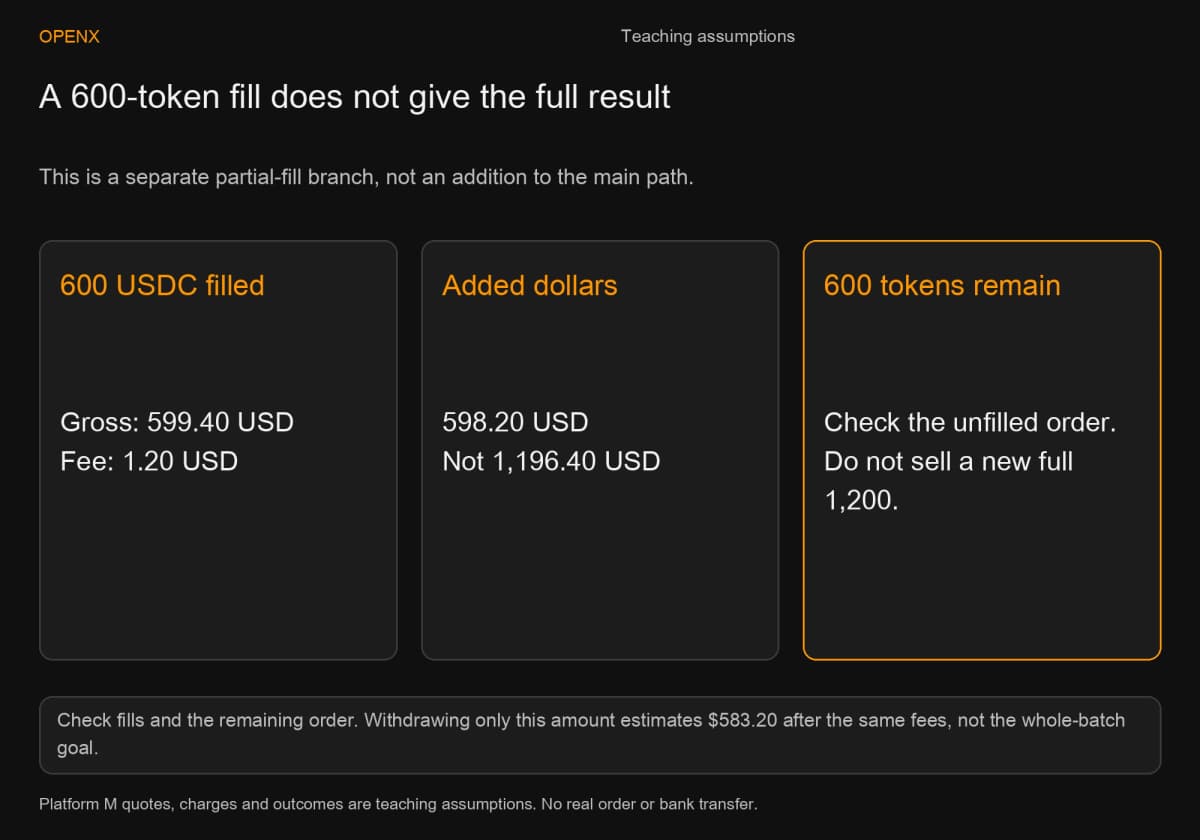
A separate branch assumes only 600 USDC fill, still at $0.999. Gross proceeds are $599.40. The 0.2% fee is $1.1988, rounded to $1.20, so the increase in platform dollars is only $598.20. The other 600 USDC are unfilled, and the corresponding order may remain open. You have not obtained the main path’s $1,196.40 or completed the exit from all 1,200 tokens.
First check the fills and remaining order, then decide whether to wait, cancel the unfilled portion or reassess the quote. Withdrawing only this $598.20 would leave an estimated $583.20 after the same two fixed charges, clearly different from the original whole-batch goal. Availability also depends on the platform’s withdrawal minimum. Do not leave the original order open while submitting a new sell order for the full 1,200 tokens, potentially letting later fills exceed your plan.
Step 6: Recheck the $1,170 minimum after a quote change
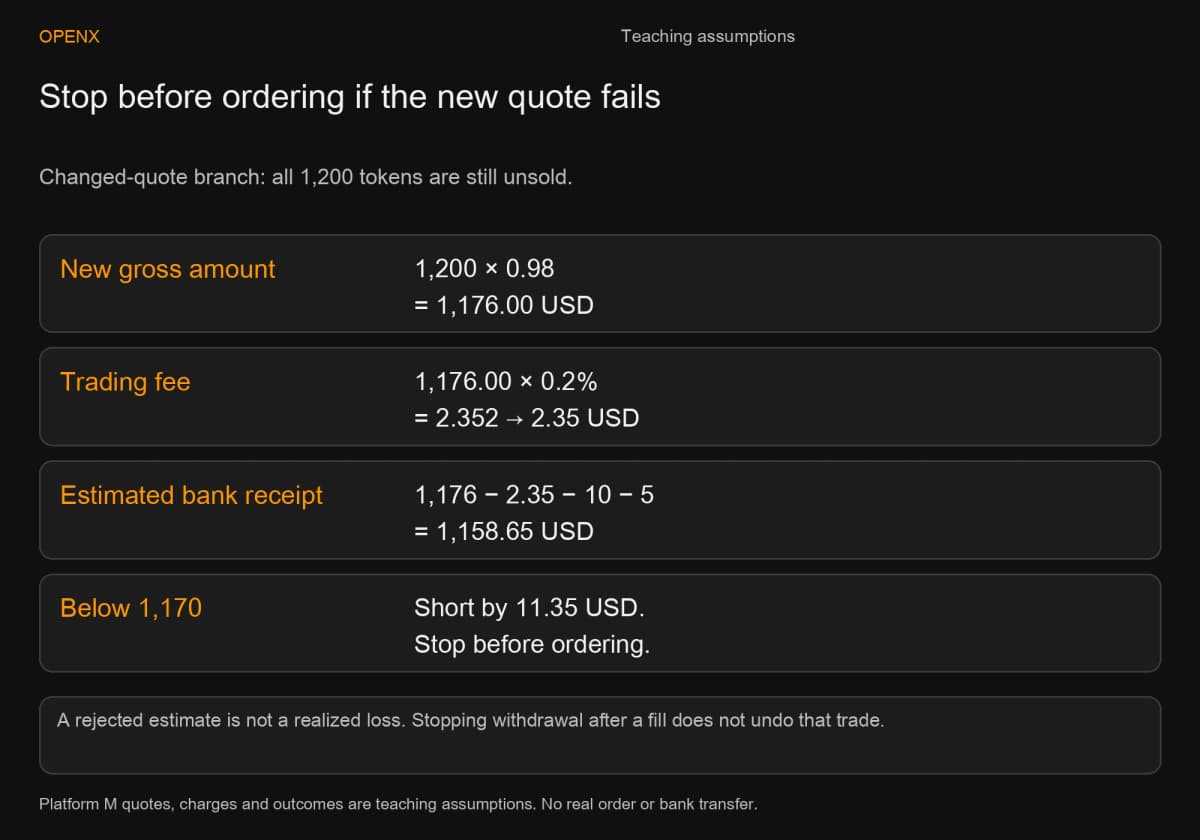
Consider another branch before any sale: all 1,200 tokens remain unsold, and the available quote has changed to $0.98. Gross proceeds become $1,176.00. The 0.2% fee is $2.352, rounded to $2.35, leaving an estimated $1,173.65 on the platform. After the $10 withdrawal charge and $5 bank charge, estimated bank receipts are only $1,158.65, which is $11.35 below the $1,170 minimum.
Stop this plan before placing the order and reassess available routes, fees and whether lower receipts are acceptable. Do not keep recording $1,181.40. This is a rejected estimate, not a realized loss. The main full-fill path, 600-token branch and changed-quote branch are alternatives, not amounts to add together. After a fill, canceling a withdrawal does not automatically buy back the original USDC; repurchasing would be a separate transaction at a different price and cost.
Before funds reach the bank, identify where the process is stuck
Unfilled orders, platform review and returned bank transfers require different evidence. For an unfilled order, check the order. If it filled but funds cannot be withdrawn, check balances, restrictions and request status. If money was sent but the bank has not received it, reconcile transfer identifiers with bank processing. The common symptom of “money not yet usable” is not a reason to solve every problem by placing another order.
A bank return does not automatically restore the original tokens either. Funds may return to a platform fiat account, await reconciliation or incur more fees. Check the actual returned amount and availability. Do not mark an unknown outcome complete or quietly lower the original $1,170 minimum. Currency conversion, additional intermediary-bank fees or unexplained deductions require new information and a revised calculation.
Keep the order ID, execution time, platform withdrawal ID and bank-credit details separately, then connect them through amounts and currencies. If a withdrawal includes dollars already held in the account, the entire bank receipt cannot be attributed to this 1,200-token sale. That is why this example starts with a zero dollar balance. If returned funds reappear, distinguish a ledger balance from an available balance and check any fees. Without a clear outcome, retain a pending status rather than working backward from the original quote to invent a completed receipt.
Build out your exit plan around the next question
You can now repeat four actions: identify an available counterparty and account, calculate full net dollars, update the estimate using actual fills, and confirm completion through usable bank funds. Reading reserve disclosures does not skip any of them. For the issuing system’s assets and liabilities, continue with reading stablecoin reserve reports and keep asset backing separate from your personal exit channel.
This article is for education and calculation practice, not investment, tax or legal advice. Teaching fees and completion outcomes are not real transaction records. Check eligibility, quotes, charges and receipts against the current service and bank conditions.